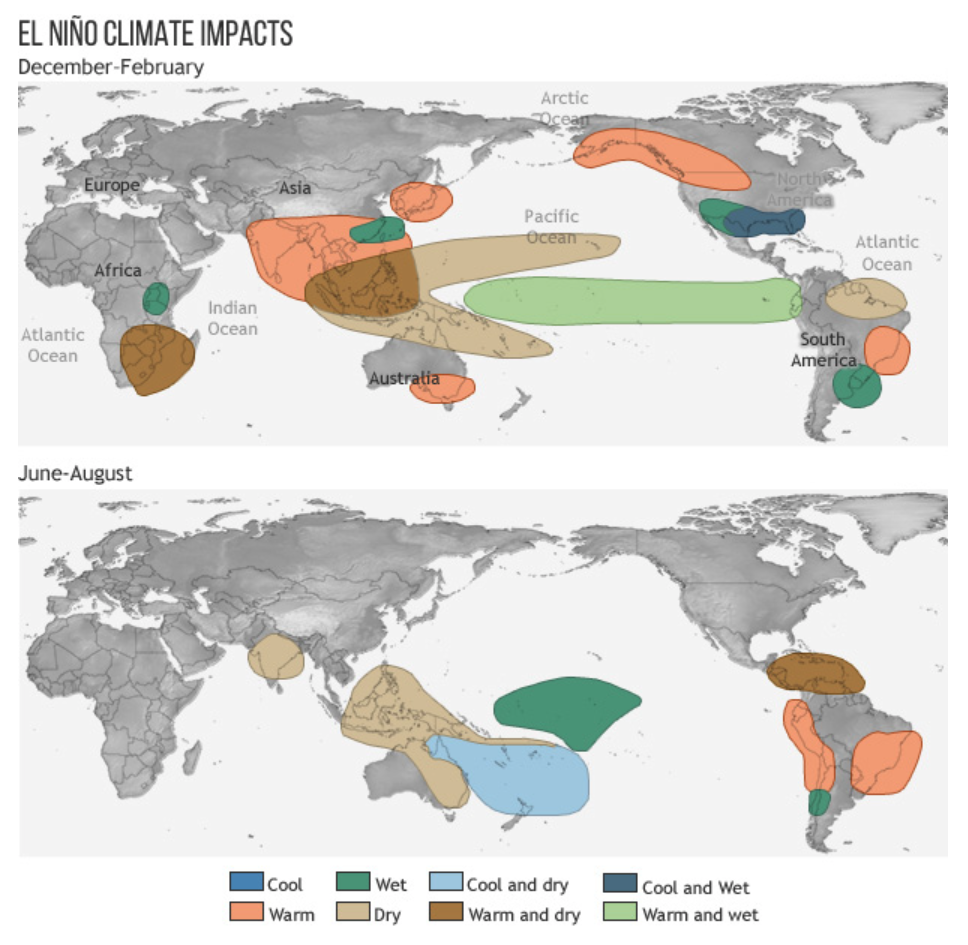
Looking further back, we can see the long-term impacts of a short-term shock. In the 1972-3 El Niño event, warm water off Peru wiped out the anchovy fishery, which at the time supplied most of the world's fishmeal for animal feed. Fishmeal prices spiked, farmers switched to soybeans, soybean prices roughly tripled, and the US briefly banned soybean exports. That ban prompted Japan, which was heavily dependent on American soy, into investing in Brazilian farmland, which is a big part of why Brazil is now the world's largest soybean exporter.
Not again!
With so much experience of El Niño events, you might think we'd know how to prepare for the next one. Yet every El Niño is unique in its own ways, and shows up in a unique situation.
This El Niño, for example, is shaping up to be a humdinger. The US National Oceanic and Atmospheric Administration is giving a 69 percent probability this El Niño will exceed the strength of every El Niño on record since 1950. It has developed quickly, and may well last longer than usual, although none of this necessarily means its impacts will be greater.
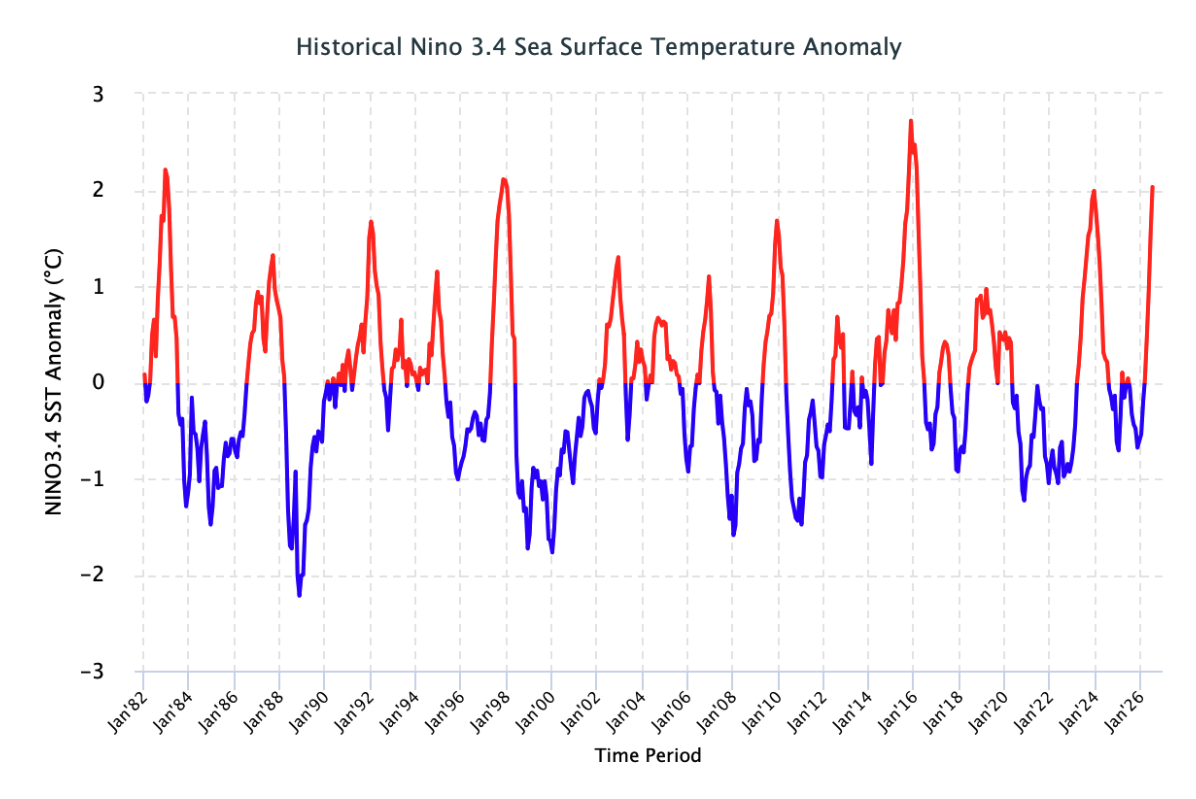 ENSO Forecast Data © 2002-2026 by International Research Institute for Climate and Society is licensed under Creative Commons Attribution 4.0 International
However, global temperatures typically rise after an El Niño, which means 2027 might well be the hottest year on record ahead of, in order, 2024, 2023, 2025 and probably, 2026.
“2027 might well be the hottest year on record.”
Each El Niño also arrives in unique geopolitical, economic and market conditions. Most critical of these at the moment is the conflict in the Persian Gulf, from where one-third of the world's fertiliser is shipped. As a result, Russia temporarily suspended exports of ammonium nitrate, and China, the world's largest phosphate producer, blocked phosphate exports. As well as improving production where the weather is fine, fertiliser can mitigate the impacts of drought in some crops, so it's absence will likely exacerbate the problems farmers face.
Food prices are already high and rising. The Food Price Index published by the Food and Agriculture Association shows prices rising strongly again, after falling from record highs in the wake of the Russian invasion of Ukraine.
Not only that, but supply chains are already pretty tight, with container rates up 40 percent in 2026. And export controls have now become de rigueur at the first sniff of a crisis, which could easily exaggerate any supply chain crisis.
On the plus side, the last few years of volatility have hardened supply chain professionals to uncertainty and primed them to be agile when their best-laid plans fall apart. A lucky few also have access to increasingly sophisticated data and systems that can help give them a heads up of danger and offer useful alternatives.
History doesn't repeat itself, but it rhymes. The lessons from previous El Niño events demonstrate there are opportunities for those who are nimble and brave enough to not just secure their organisation's supply chains, but provide strategic counsel on the opportunities.
Where does "El Niño" come from?
The name El Niño (The Boy) comes from El Niño de Navidad (The Christmas Child), which was what Peruvian fishermen called the arrival of warm water every few years around Christmas. To keep the naming convention, the weather phenomenon where the prevailing winds blow warm water westward more strongly become known as La Niña (The Girl).