Sub-Saharan Africa, while starting from a lower base, is expected to see some of the fastest regional growth rates over the next decade, supported by high population growth and expanding high-net-worth populations. Although its wealth levels remain modest by global standards, Africa’s economy and private wealth sectors are expanding faster than those in advanced economies, with projections of substantial growth in the number of millionaires and wealth hubs.
“Africa’s economy and private wealth sectors are expanding faster than those in advanced economies.”
“As we move to 2050, we have to make some assumptions about the state of the world. If the new normal is chaos, we may see a dis-integration of the globalisation era and a procurement and manufacturing capability based on increased localisation,” says CIPS global economist Dr John Glen.
"However, with the emergence of Africa and the continued growth of Asia, the economic benefits of a new globalisation as opposed to regionalisation will prove to be too attractive,” he adds. “In this context, the identification of procurement opportunities in a global context and the creation of resilient supply chains will be the key challenges procurement professionals will face. One can only hope that they are allowed to do so in a geopolitical environment that is significantly better than that which exists now.”
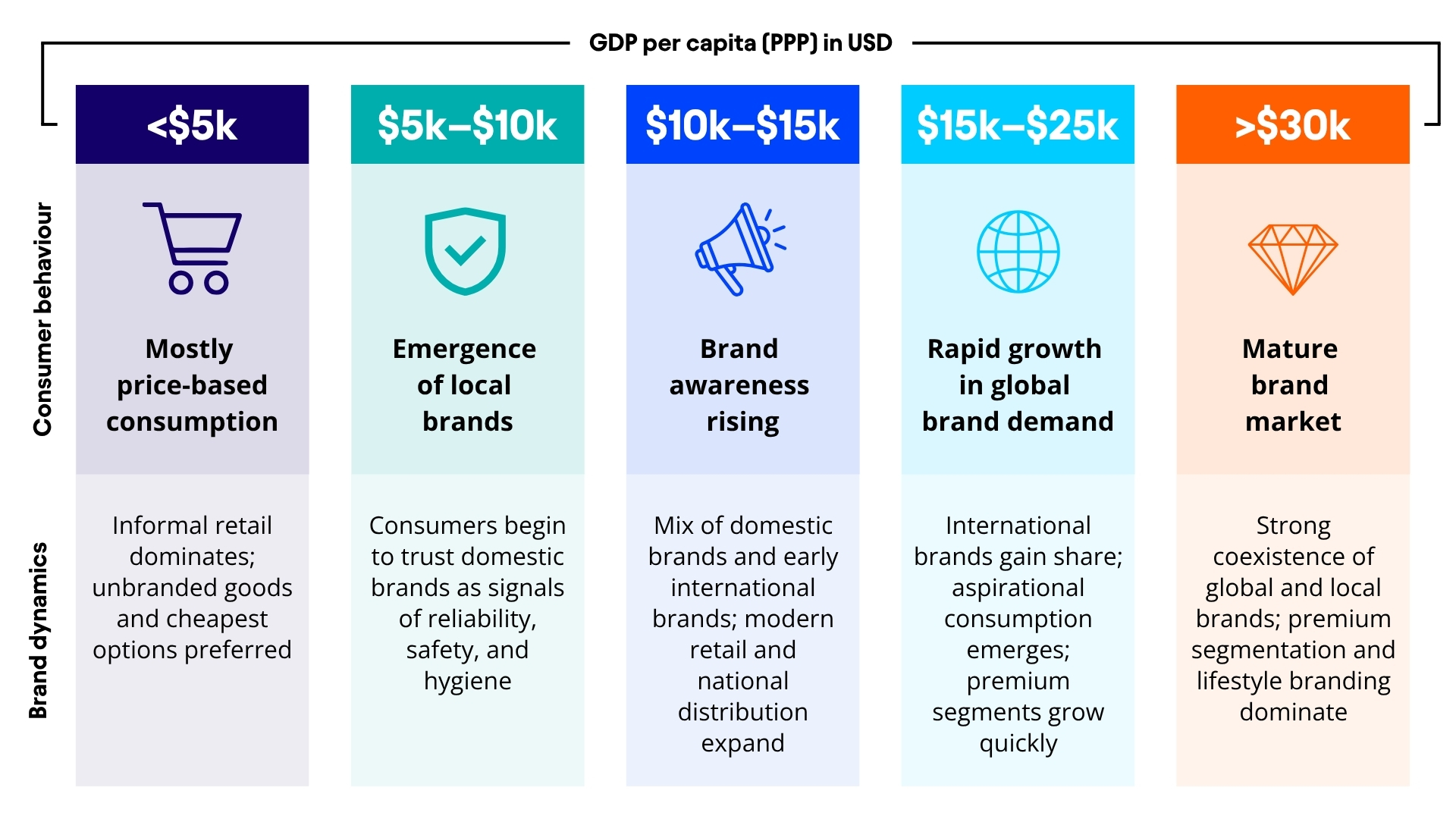
In terms of the types of goods that will be demanded, emerging and middle-income countries follow a predictable path. Outlined in the table above
Yet despite these shifts, global inequality is projected to persist into 2050. Under business-as-usual scenarios, the poorest half of the global population is estimated to see only modest gains in income share, with the richest one per cent’s share remaining elevated. Such estimates underscore that regional growth alone will not materially rebalance global wealth distribution without accompanying policy changes.
And as with migration, the current public debate on this topic often overlooks the potential impact of climate change and the vast changes it may entail. Many of the fastest-growing economies of recent decades, for instance, are set to be hardest hit by rising temperatures and extreme weather – with key countries like India, Bangladesh, Nigeria and Turkey all facing very different economic futures if even more moderate projections of climate impacts prove accurate.
At the same time, the global energy transition promises radical shifts in the wealth and investment flows between countries that formerly relied on fossil fuel extraction to enrich themselves. Already wealthy OPEC countries like Saudi Arabia and the UAE are taking bold steps to diversify their economies in time for an age where influence on global oil prices is no longer the powerful lever it was for much of the 20th century.