
The Strait that holds the world to ransom

Written by: Tomasz Tyras
Written by: Tomasz Tyras
About Tomasz Tyras
Tomasz is a supply chain and operations expert with Wilhelm Schüssler Spedition GmbH, a freight forwarding service. He lends his expertise to detail how the Strait of Hormuz matters to supply chains.
Why the Strait of Hormuz is the single most consequential chokepoint in global supply chains, and what procurement professionals need to understand about the exposure it creates.
Picture a procurement manager in Seoul, a plastics buyer in Frankfurt, and a fertiliser trader in Nairobi. Three different industries, three different continents, three people who have probably never met. In the spring of 2026, all three found themselves staring at the same emergency on their screens: a maritime corridor no wider than the city of Bristol had, once again, brought the global economy to the edge of its seat.
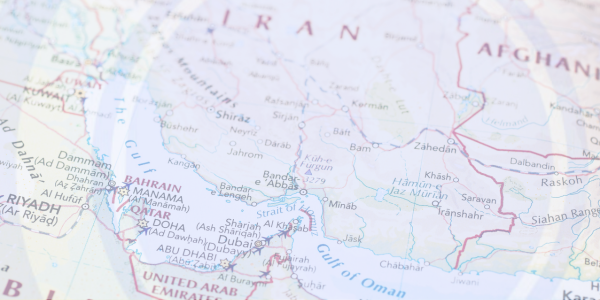
The Strait of Hormuz - a 21-mile-wide passage between Iran to the north and Oman and the United Arab Emirates to the south - is not, on any map, a particularly impressive stretch of water. What makes it extraordinary is arithmetic. Every single day, roughly 20 million barrels of crude oil and petroleum products pass through it, accounting for approximately 25% of all seaborne oil trade worldwide [1]. Alongside that energy cargo, travels one-fifth of the world’s liquefied natural gas [2], the feedstock for the plastics buyer in Frankfurt, the power plant operator in Tokyo, and the chemical producer supplying automotive parts across Europe. It is, to borrow a phrase used quietly in boardrooms and risk committees, the jugular of global trade.
A chokepoint by design
What makes Hormuz structurally different from other disruption risks, like a factory fire, a port strike, or a flood, is that there is simply no like-for-like alternative. A partial workaround does exist: Saudi Arabia’s East-West Pipeline can bypass the strait, carrying up to five million barrels per day, and the UAE’s Habshan–Fujairah pipeline offers additional relief capacity [3]. However, even at full utilisation, both pipelines together can divert only a fraction of the volume normally transiting the waterway. The rest must either go through or go nowhere.
For procurement professionals, this is the source of a specific and uncomfortable truth: a significant portion of the world’s industrial supply chains run through a geography that a single state actor can threaten to close. Iran has done so before - threats were issued in 2012, during the nuclear sanctions standoff, and again in 2018 and 2019 - and as escalations in early 2026 demonstrated, the threat never entirely leaves the table.
"A one-quarter closure of the Strait for a single quarter would reduce global GDP growth by an estimated 2.9 percentage points", Federal Reserve Bank of Dallas, March 2026 [4]
The scale of exposure
To understand the supply chain exposure properly, it is worth moving beyond energy. The strait does not merely carry oil tankers. UNCTAD data shows it handles approximately one-third of the world’s seaborne fertiliser trade [5], much of it originating from Qatar and the UAE. Qatar alone accounts for 93% of its LNG exports through the strait [6]. Disrupt the waterway, and you disrupt the nitrogen that feeds crops across South Asia and sub-Saharan Africa. The food security implications are rarely mentioned in shipping briefings, but they are real.
- 20M barrels of oil per day transiting the strait in 2025 - 25% of all seaborne oil trade [1]
- 20% of global LNG trade passes through Hormuz, including 93% of Qatar’s exports [2]
- 1/3 of the world’s seaborne fertiliser trade depends on the strait remaining open [5]
For petrochemical supply chains, the exposure runs deeper still. The Gulf states account for a significant share of global ethylene production capacity - the foundational building block for plastics, packaging, coatings, and automotive components. Events in March 2026 illustrated this with painful clarity when infrastructure damage to Qatari LNG terminals cascaded into force majeure declarations across petrochemical producers in Asia, with polyethylene prices rising 40–50% in the region within weeks [7]. Procurement teams sourcing polymer inputs for consumer goods manufacturing were left managing price spikes with little cover. Spot market availability had contracted sharply, and contract pricing had not anticipated an event of this magnitude.
Procurement risk: what actually gets disrupted
When supply chain professionals discuss Hormuz risk, the conversation often stays at the macro level: oil prices, geopolitical headlines, GDP forecasts. The procurement exposure is more granular, and more actionable, than that framing suggests.
Energy cost pass-through. The most immediate transmission mechanism is energy cost. When Brent and Dubai/Oman crude prices moved to $169-182 per barrel in March 2026 [8], the effects flowed almost immediately into logistics costs, manufacturing energy bills, and resin prices. Any procurement category with meaningful energy intensity, like aluminium, glass, ceramics, chemicals, and food processing, carries latent Hormuz exposure even if it sources nothing directly from the Gulf.
Shipping costs and insurance premiums. War-risk insurance premiums on vessels transiting the region surged from around 0.25% to 1-3% of vessel value during the 2026 escalation [9]. The practical effect: a tanker voyage that previously cost $500,000 all-in was approaching $7 million in risk-adjusted terms [9]. Those costs do not disappear - they travel up the supply chain in the form of elevated spot freight rates and contract renegotiation requests. Buyers locked into long-term freight agreements may find themselves in disputes about force majeure and change-of-circumstance clauses that they had not thought to stress-test.
Rerouting costs and lead-time extension. Where vessels do reroute to avoid the strait, freight costs have risen by an estimated 5-20%, depending on origin and destination [10]. For supply chains already thinned by just-in-time inventory strategies, an additional 10-15 days of lead time - the rough cost of rerouting around the Arabian Peninsula - can tip a manageable shortage into a stockout. This is where procurement resilience, or the lack of it, becomes visible in real time.
Critical materials beyond oil. Helium - a byproduct of Qatari natural gas extraction and essential for semiconductor manufacturing - is among the less-discussed exposure items. South Korean chip fabricators, including Samsung and SK Hynix, source a material share of their helium requirements from Qatar [11]. The semiconductor supply chain, still recovering from the shocks of the early 2020s, carries a Hormuz dependency that most technology buyers have not mapped.
What procurement teams should be doing
The Strait of Hormuz is not a new risk. What is new is the regularity with which it moves from background concern to active crisis - and the degree to which procurement functions have been slow to embed it into their supply chain risk frameworks in a meaningful way.
The starting point is exposure mapping. Procurement teams need to move beyond first-tier suppliers and ask a harder question: where in my supply base does Gulf energy, Gulf petrochemicals, or Gulf logistics capacity sit two or three tiers down? The answer, for most industrial and consumer goods manufacturers, is “closer than we thought.”
Beyond mapping, the practical levers are familiar: dual-sourcing for high-exposure input categories, strategic inventory buffers for materials with long lead times and no viable alternative, contract language that explicitly addresses price escalation mechanisms and shipping cost pass-through, and scenario-planning exercises that model the procurement cost impact of a sustained strait closure at 30, 60, and 90 days.
There is also a governance dimension. The Hormuz risk is systemic enough that it warrants board-level visibility, not simply a line on a commodity risk register. When the Dallas Fed models a 2.9 percentage-point hit to global GDP from a single quarter of closure [4], the conversation moves from a procurement operational risk into enterprise risk territory.
The Seoul procurement manager, the Frankfurt plastics buyer, the Nairobi fertiliser trader - none of them works in energy. None of them would describe themselves as exposed to Middle Eastern geopolitics. And yet, in a world where 21 miles of water separates stability from disruption, the supply chains of the twenty-first century leave very little room for that kind of distance.
The Strait of Hormuz has always mattered. The question now is whether the organisations responsible for securing supply chains have built frameworks that take it seriously, or whether they are, once again, discovering its importance in real time.
References
- International Energy Agency (IEA) (2026). Oil Market Report: Hormuz transit volumes.https://www.iea.org
- IEA / UNCTAD (2026). LNG trade through the Strait of Hormuz; Qatar export dependency.https://unctad.org
- S&P Global Energy (2026). Gulf bypass pipelines: capacity and limitations.https://www.spglobal.com/commodity-insights
- Federal Reserve Bank of Dallas (2026, March). What the closure of the Strait of Hormuz means for the global economy.https://www.dallasfed.org
- UNCTAD (2026). Seaborne fertiliser trade and Hormuz dependency.https://unctad.org
- IEA (2026). Qatar LNG: export routes and Hormuz reliance.https://www.iea.org
- S&P Global / C&EN (2026, March). Petrochemical supply chain impact: ethylene and polyethylene price escalation in Asia.https://www.spglobal.com
- S&P Global Commodity Insights (2026). Dubai/Oman crude benchmark: March 2026 price movements.https://www.spglobal.com/commodity-insights
- Economist Intelligence Unit / Marsh McLennan (2026). War-risk insurance premiums: Hormuz escalation, March 2026.https://www.eiu.com
- Locus (2026). Freight cost impact of Hormuz rerouting.https://www.locus.sh
- Reuters / CNBC (2026). Helium supply disruption: Qatar gas infrastructure and semiconductor sector impact.https://www.reuters.com