
Pulling through supply chain volatility: how Oxford Nanopore mastered demand-driven planning

Written by CIPS Knowledge & Insight
Written by CIPS Knowledge & Insight
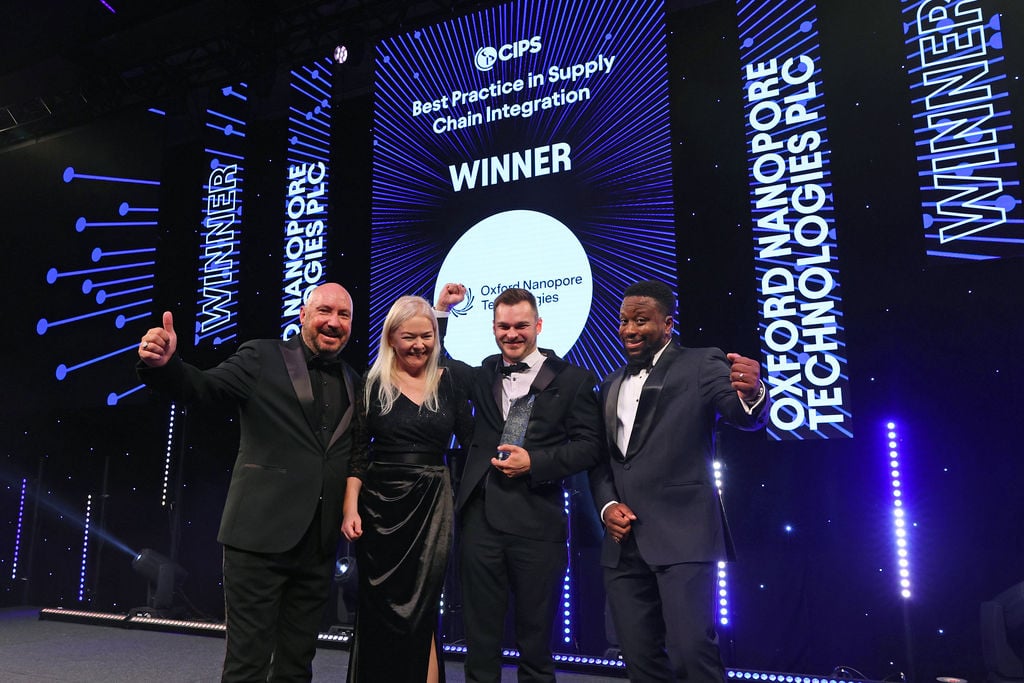
In a supply chain landscape increasingly defined by uncertainty, relying on static forecasts is a risky game – and for Oxford Nanopore Technologies, a global pioneer in innovative DNA sequencing technology, the need for dynamic supply chain planning is critical.
And while inventory reduction and operational improvements are tangible outcomes of their recent work, the ultimate objective is better service for customers. By aligning inventory with real demand and dynamically adapting to changing conditions, a switch to Demand Driven Material Requirements Planning (DDMRP) helps Oxford Nanopore protect product flow, respond more effectively to changing requirements and identify risks earlier, creating a stronger foundation for a reliable customer experience.
Ollie Jones, associate director of supply planning, says the evolution to a new supply chain planning process has been a critical move to support the next phase of scaling – winning two CIPS Excellence Awards in the process.
Oxford Nanopore Technologies produces complex products merging software, hardware, biologics, and chemistry to characterise DNA and RNA. The technology brings valuable knowledge and insights on cancer, human genetic disease, infectious disease, as well as helping the biopharma industry to design and make better products, faster. Its products include DNA sequencing devices, some of them only the size of phones, and kits for the preparation of biological samples.
The potential of this technology for public health and medical practice is vast, and it is important for a scaling company to be able to meet demand changes while also maintaining its pace of innovation. Disruption can happen – this was made all too clear during covid, when patterns of demand changed due to the technology’s usage in epidemiology of the virus, against a backdrop of already challenged supply chains.
"In complex industries, forecasts can be, by their nature, quite inaccurate," explained Ollie Jones, Oxford Nanopore’s Associate Director of Supply Planning. "We know we're rapidly growing, demand is changing and we operate in a complex supply chain, so looking backwards isn’t really a great option for us."
For Oxford Nanopore, the solution was an evolution from leading with forecasting towards actively tying replenishment with real time orders. This new methodology, Demand-Driven Material Requirements Planning (DDMRP), prepares the company to manage its supply chain in a growth journey ahead.
The forecasting fallacy versus the pull of demand
Traditional Material Requirements Planning (MRP) relies on a master production schedule dictated by long-term forecasts, with planners ordering materials based on what sales teams predict will happen. In fast moving environments, that can create supply chain risk that doesn’t serve customers or companies well.
DDMRP flips this script. Rather than pushing stock based on a forecast, it pulls stock based on actual demand, drawing on continuous monitoring and daily data readjustments rather than static yearly targets.
The methodology has four pillars:
- Positioning: Strategically deciding where to hold stock across the supply chain, whether as raw materials, work-in-progress, or finished goods, depending on acceptable customer lead times.
- Protecting: Calculating the right amount of stock to hold based on lead times and variability, mitigating risks without holding excess inventory.
- Pulling: Pacing procurement entirely to actual orders rather than anticipated sales.
- Adapting: Continuously reviewing and adjusting buffers based on average usage, supply chain stability, or impending global events.
Jones explained to CIPS how it feels to deploy DDMRP in practice.
“First up, where do you want to hold stock? If you're in an Amazon-type business where you need to do next day delivery, you'll have it in finished goods, ready to go. If your customers are a bit more flexible, you can hold raw materials instead and then convert based upon what you need. This is part of what resiliency means: holding not too much, not too little, but the right amount of stock, the ‘Goldilocks’ amount.
“Depending on your business, you might set a rule where you hold eight weeks of stock, or you can be more future-looking, plan for disruption and protect yourself to offset any instability,” Jones continues. “This is all about ordering to fill actual orders, not your forecast.”
While implementing the planning process across your supply chain does require DDMRP compliant software, Jones says that it’s a methodology at its heart. “You could test and validate the solution would work for you first via Excel if you wanted to start somewhere.”
Adding strategic value beyond unit cost
For procurement and supply chain professionals, DDMRP offers a tangible way to demonstrate strategic value beyond negotiating unit price reductions.
Having decided to challenge existing practices, such as holding a set amount of stock at all times, Oxford Nanopore ran simulations and proved they could safely reduce part of their finished device inventory by 43%. That’s a significant reduction, releasing cash tied up in working capital and improving cash efficiency.
And for an R&D-heavy technology company like Oxford Nanopore, preserving cash is an important enabler of growth.
DDMRP also fundamentally changes the total cost of ownership (TCO) equation. Jones recalled a previous role in a different company, where nearshoring metal castings from Taiwan to Sheffield seemed unviable on unit price alone, until he factored in the vast amount of buffer inventory required to mitigate a three-month shipping lead time. Once he saw the results, it was clear that localised sourcing was the obvious choice.
Engaging suppliers and empowering planners
The shift to DDMRP also naturally alters supplier relationships. Instead of issuing forecast-driven commitments that may change significantly from one quarter to the next, Oxford Nanopore now aims to provide suppliers with a consistent flow of smaller, more frequent orders. While negotiating volume will always be dynamic processes, Jones believes the consistency DDMRP offers is a significant benefit to suppliers.
Internally, the transformation has helped Oxford Nanopore’s supply chain planning team better manage demand and bring clarity to data. "As the planners, there is more confidence in our processes. We get clear, visible signals and can respond quicker to exception-based priorities," Jones said.
The reality of change management
Implementing DDMRP is not a quick fix, as Oxford Nanopore discovered. The journey took time and required the knowledge and contextual awareness of supply chain professionals who understood the company’s operational realities to get it right.
The teams were empowered to act as internal "change agents". They spent extensive time mapping products, understanding gaps, and closing the divide between the theoretical system and the people using it.
Jones recognises that DDMRP is not a universal cure-all. The company still uses forecasts to manage buffer setup. But for organisations like Oxford Nanopore navigating supply chain unpredictability, bringing DDMRP into the supply chain planning mix has helped build greater resilience to shocks and demand fluctuations.
And ultimately, that resilience is critical in a world that isn’t standing still.
Oxford Nanopore Technologies took home Best Practice in Supply Chain Integration and the Overall Winner award for their use of DDMRP at the CIPS Excellence in Procurement & Supply Awards 2025.
Related articles
Force majeure: what procurement needs to know
A backdrop of geopolitical turbulence, supply chain shocks and shipping disruptions have put the spotlight on force majeure contract clauses. But when is force majeure legitimate? And when might it be opportunism?
Future lessons - from the history of procurement
What wisdom can we extract if we look at the history of procurement, and how does this apply to the future of the profession? CIPS chief futurist, Dr Graham Norris, offers a perspective as part of The Great Conversation.
Top three ways companies can manage a procurement and supply crisis
Supply chain and risk consultant Nick Wildgoose offers three pieces of advice here that all, in some way, relate to having deep knowledge of your supply chain across multiple tiers.