
Supplier Preferencing Matrix
Explore the Supplier Preferencing Matrix, its uses in procurement and supply, and how to apply it successfully.
What is the Supplier Preferencing Matrix?
The Supplier Preferencing Matrix, developed by Steele and Court, is a model to view the relationship from the supplier’s perspective. By understanding how a supplier perceives your account within their customer portfolio, you can gain valuable insights into their likely behaviour, pricing strategies, and service levels.
This matrix enables you to evaluate how critical your business is to the supplier in terms of revenue, strategic importance, and operational fit. If a supplier sees your account as highly valuable, they may prioritise your needs, offer competitive pricing, innovative solutions and prioritise delivering exceptional service. Alternatively, if your account is viewed as less significant, you might face higher prices, lower prioritisation during peak demand, or reduced service levels.
By leveraging this analysis, you can anticipate and manage the dynamics of your supplier relationships, negotiate more effectively, and develop strategies to elevate your importance with strategic suppliers, focus and develop stronger relationships where appropriate to maximise opportunities and mitigate risks.
What are the four key quadrants in the Supplier Preferencing Matrix?
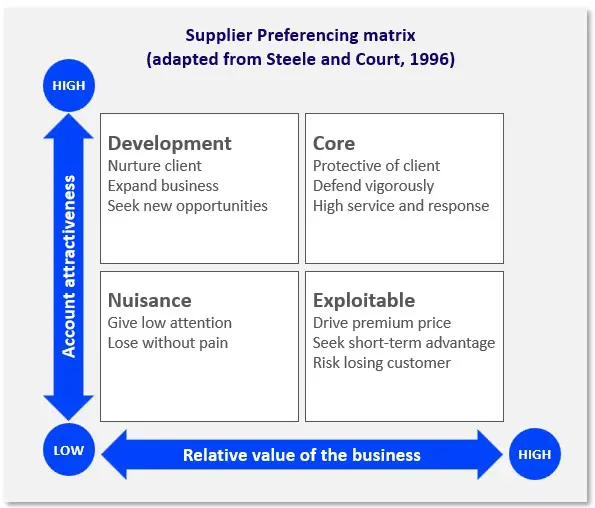
The Supplier Preferencing Matrix categorises customers into four key quadrants based on account value (financial contribution) and account attractiveness (strategic importance). These quadrants can help you to understand how suppliers prioritise your account:
- Nuisance: Low value and low attractiveness. These accounts drain resources and offer little benefit to the supplier. Suppliers may reduce engagement or phase customers out entirely. Buyers in this category should aim to increase spending to raise the account attractiveness or consider alternative suppliers.
- Development: Low value and high attractiveness. Suppliers see the potential for growth and may invest in nurturing the relationship. Buyers should focus on discussing future value and opportunities to maintain supplier interest and support.
- Exploitable: High value and low attractiveness. While these accounts bring significant revenue, suppliers may view them as low priority for strategic focus or investment. Buyers should avoid over-leveraging their position and work to enhance strategic alignment, especially if they supply core products to their business.
- Core: High value and high attractiveness. These are the most valued customers, receiving priority treatment and closer collaboration. Buyers should sustain this position through mutual value creation and balanced reliance on the supplier.
What are the benefits of using the Kraljic Matrix and the Supplier Preferencing Matrix together?
Using the Kraljic Matrix and the Supplier Preferencing Matrix together provides a powerful tool to analyse and manage buyer-supplier relationships. The Kraljic Matrix focuses on the procurement perspective, categorising products or services based on supply risk and strategic importance. The Supplier Preferencing Model focuses on the supplier's perspective, assessing customers based on value and attractiveness. By overlaying these two models, procurement and supply professionals can map their relationships across 16 different scenarios, enabling them to tailor their strategies for collaboration, negotiation, and risk management.
Supplier preferencing matrix key themes
Listen on demand and get the latest practical insights from our panel of procurement and supply experts.


Supplier Relationship Management Webinar
Learn how to form collaborative supplier relationships with insights from leaders of award-winning transformation programmes.
Fostering collaboration: Excelling in supplier relationship management
Access the latest research, whitepapers and tools across a range of key procurement and supply topics.
Expand your supplier relationship management skills

On this page