
Generation and capture of value in supply chains
Value generation is defined as “incremental improvements resulting in a soft (unquantified) or hard (quantified) benefits”. (CIPS, 2021)
CIPS members can record one CPD hour for reading a CIPS Knowledge download that displays a CIPS CPD icon.
Summary
This document looks at how the output of the procurement process contributes to the capture, generation, and protection of value in supply chains. It also discusses the concept of performance measurement, and suggests how procurement activities can be measured in terms of value added, in terms of both cost reduction and wider organisational strategy.
Definition
Value generation is defined as “incremental improvements resulting in a soft (unquantified) or hard (quantified) benefits”. (CIPS, 2021)
Introduction
If we are to demonstrate the effectiveness and efficiency of the procurement function’s output, we must understand the limitations around existing measures of performance, and the nature of value for the organisation and its customers. Failure to use the concept of value risks procurement being constrained, and ultimately threatened, by not being assessed or appreciated for its broader contribution.
Bringing greater clarity to the meaning of “value” and how it impacts on the function’s deliverables, will help procurement and supply professionals to:
- articulate value and demonstrate their contribution to its capture, generation, and protection
- understand the limitations around existing measures of procurement’s contribution
- focus their attention on how and where their efforts will create maximum benefit
- focus on the strategies rather than the processes and tools that are available to capture, generate, and protect value
- help develop more appropriate value-based measurements and targets
The authors believe that the ideas developed in this document are applicable to organisations in all sectors – whether private, public or not-for-profit.
Performance measurement
Performance measurement can be defined as “the process of determining performance measures, assessing performance and taking corrective action to improve performance” (CIPS, 2021).
Procurement has grown in status in recent years and there is increasingly clear recognition of its importance as a key business function. Yet there is still no agreed method of assessing the output or efficiency of procurement activity, or its contribution in generating or securing value for organisations.
While the science of measurement is all around us – for instance, as consumers we discuss cars in terms of their miles/litre petrol consumption – performance measurement of organisations remains, after many years and the application of considerable brainpower, a cause of considerable debate and challenges.
Traditionally, the performance of businesses – and many other organisations – have been broadly measured in the following three ways:
Annual financial reports
Built on the foundations of business book-keeping records, annual financial statements report on the company's assets and liabilities, stockholders' equity, long-term debt, net earnings and net revenues. However, even in these relatively few key areas, practices around the world vary because different responses have evolved, due to local practical problems, such as inflation, or the advent of new business models such as leasing.
When applied to financial reporting the term measurement can give a misleading impression of certainty and objectivity. In daily life measurements are typically made of the characteristics of physical objects, while subjects of measurement in financial reporting are abstract concepts of uncertain meaning, such as income and net assets. For this reason alone, their measurement is always liable to be controversial.
The first attempts at measuring procurement’s performance were based on financial accounting and attempted to assess the monetary benefits achieved. Initially, this involved simple statements of the discounts achieved, from which was calculated an estimate of the monies saved. This approach gathered pace as companies engaged in major process re-engineering in the early 1990s. While the focus often resulted in significant gains, the savings proved difficult to track, and even more difficult to sustain. Often claimed efficiency savings were found to be either substantially incorrect or subject to measurement issues and uncertainty.
Business metrics
Originally annual financial statements were only intended to give an account of the last year’s stewardship of the company to the board of directors but nowadays many other groups, both internally and externally, want to use the information for other purposes and this has resulted in the second measuring system, usually referred to as business metrics.
Business metrics refers to the practice of taking financial and workforce figures and manipulating them, usually by dividing one measurement by another, to compare performances in individual companies over time, and between different companies and industries. The resulting ratios are used both externally and internally in the following ways:
- External: Business analysts use ratios from company annual reports to advise shareholders, banks and so on, on the relative performance of companies and economic sectors, and to try to predict future performance to help the efficient working of capital markets.
- Internal: Companies use the above business metrics, and other internal business measurements (more commonly known as management ratios) to help diagnose situations, monitor performance, and help with planning and target setting. As an example of the difference between business and management ratios, the former could be sales per employee, and the latter (because of the extra information available within the company) might be sale per sales & marketing department employee.
This apparently simple process can unfortunately be misleading, as Figure 1 below illustrates.
The sales growth of Firms A and B in the same industry over the past year have been 10% and 30% respectively. This implies that Firm A has performed rather badly. But Firm A’s performance is put in a very different perspective if market share is considered:
|
Market share (%)
|
Market share (%)
|
|
|---|---|---|
|
Firm
|
A
|
B
|
|
Now
|
55
|
13
|
|
A year ago
|
50
|
10
|
From this perspective, Firm A has performed better with a 5% increase in market share compared with only 3% for firm B.
Management ratios applied to procurement have included orders or invoices per procurement employee, or total procurement department cost divided by the number of orders. This has led to many critical comments about orders costing £40 being used to buy, for example, a £30 hammer, while ignoring the fact that a £20m plant order was also placed for a cost of only £40. The use of such ratios has declined as the emphasis in procurement has moved away from a transactional exercise towards a broader, more strategic role.
Key performance indicators (KPIs)
The third way of measuring the performance of organisations has been the KPI, or key performance indicator. These are a quantifiable measure that can be used to assess performance over time. Often in supplier contracts KPIs will be set around many factors such as quality, cost and delivery (CIPS, 2021).
Many companies have taken up this approach on the back of developing a measurement framework approach to managing performance. Such measurements tend to emphasise certain aspects of a job, often leaving staff feeling that they do not receive adequate recognition for the real variety and totality of their roles. Another worrying aspect of KPIs is that their numbers can escalate to alarming levels.
KPIs, however, have an extra unique danger. Lacking the constraints of financial reporting and the relative constraints of business/management ratios, indicators can be anything we believe and choose. This was graphically illustrated when an international oil company was criticised after a deadly plant explosion for using the monitored level of personal injury rates as an indicator of process safety of the plant.
Setting good KPIs is key to avoiding this type of error. They should be relevant, have clear definition, be easy to understand and use, be comparable, verifiable, cost effective, unambiguous, attributable, responsive, avoid perverse incentives, allow innovation, be statistically valid and timely, and correspond to the performance criteria as closely as possible.
However, one fundamental problem is that most performance metrics only measure levels of activity versus activity targets. Typical examples from procurement might be to measure the number of contracted suppliers or to reduce the number of companies in the supply base. Such targets say nothing about what contract, versus non-contract, procurement is delivering, or that reducing supply base as an objective in itself is meaningless and that supply base rationalisation can be the enemy of effective procurement spend management (Heinzmann, 2018).
It is tempting to think that better business metrics might be developed in the future to mitigate these criticisms. For some, such as delivery performance, quality of goods and service, and whole life costs, it is probably true that we will be able to use information technology to help us make more appropriate sourcing decisions. However, business complexity continues to expand, and while waiting for technology to catch up, we risk missing out on addressing the new focus on sustainability and environmental, social and governance (ESG) issues that are presenting increased uncertainty and risk to brands and the long-term profitability of all organisations.
If procurement is to continue to be regarded by the majority as a key business process, it must find a means to clearly define its outputs to its varied customers in such a way that does not lead to multiple disparate metrics and KPIs. It must also articulate these outputs in terms of the benefits to the customer rather than “number of contracted suppliers”, for example.
(This paper considers procurement’s role in the generation and capture of value in the supply chain, but it may also be useful to consider this in the context of the wider business. See appendix A for more information.)
Modern supply chains
Having considered the concept of value in general, the next step is to see how this might be applied to procurement in modern supply chains, and how supply chain thinking might illuminate general ideas on value. (To identify value opportunities in the supply chain see Appendix B.)
As a first step let’s examine the implications of the model shown in Figure 2. This shows a simplified representation of a fairly typical modern supply chain.
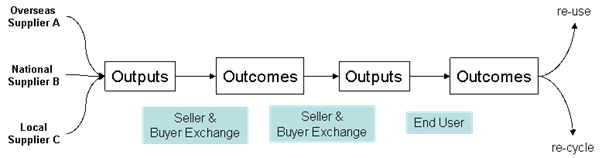
The above figure shows two key features of modern supply chains, namely:
- They are getting longer. This is true in the geographical sense that products and services are increasingly being obtained from low-cost sourcing countries around the world, but supply chains are also becoming longer because it is becoming increasingly important to go beyond the sale to the end-user customer and consider how a product can be safely and environmentally disposed of, or better still, recycled, in total or in part, for continued use. Both aspects clearly have considerable implications for the “value” in the supply chain.
- The numbers of suppliers, and the complexity with which they are combined, has increased. This yields cost savings and other aspects of value, but it is also important to consider the downsides. When humans first started to produce a surplus over subsistence needs, it’s certain that the first items they traded were things that they had already made for themselves, such as warm coats from sheep’s wool or shoes from the hide of a cow. In other words, they had first-hand experience of the “value” of the item in question, both from the point of view of the total effort that went into its production, but also from the benefits arising from its use, and this must have guided their decisions when making a trade.
In contrast, in a modern supply chain there are tens of suppliers and hundreds of employees and, in the end, none of the latter may ever own or use the product or service they are part of producing. This, we believe, is in part responsible for many modern organisations focusing on their relative competitiveness, profitability, and benchmarking exercises, rather than an intrinsic view of their value to their customers.
Transfer of value and risk
Although only one schematic supply chain is shown in Figure 2, it represents two situations from the procurement department’s point of view. One is the commonly shown situation of a producer finally selling on to the end-user customer, whether this is another organisation or an individual. In these cases, sales and marketing will generally be responsible for discovering what the end-user customer values and act as the “voice of the customer”.
However, there is another important circumstance: when the procurement department procures materials that are used to support production and delivery fulfilment of good or services. If these materials are not consumed in this process, they become assets of the organisation. Regarding these items, the procurement department stands in respect of the internal customers of the organisation (for example, production managers, maintenance and design engineers, IT, personnel department, and sales and marketing) in the same relationship as sales and marketing to the external end-user customer. In this situation the procurement department takes the marketing department’s role of determining what these customers value, both in general and regarding specific goods and services.
As VAT (value-added tax) recognises, each organisation in the supply chain adds value until eventually the head of the supply chain incorporates all these subcomponents, together with its own added value, to produce the final product. The next transaction in the supply chain, however, is uniquely different because the apex of the value-adding process has been reached, and from this point, value is extracted from the product by the end-user customer. To represent this important distinction, and to generalise it to cover both goods and services, we have labelled the end point of the value-adding process, the output, and the value extraction process the outcome.
Traditionally, in commercial organisations the buy/sell transaction has been seen as the culmination of the supply chain process, with the output being exchanged for money. But this is just the beginning of a new chain of events, which may well last longer than those of the value-adding stage. Public service organisations are more familiar with the distinction between outputs and outcomes, but because the lack of customer choice circumvents the survival imperative that direct sales feedback gives to commercial organisations, public services have tended to place even more reliance on activity output targets, rather than end-user valuations of individual outcomes.
The transfer of ownership that occurs on payment of the selling price is the instance at which risk moves from the shareholder – if this is a commercial company – to the buyer. Only time will tell whether the risk was a reasonable one and whether the customer really did get value for money for the goods or service purchased. For example, a vehicle manufacturer’s output could be a car, with the buyer’s outcome being a comfortable, reliable means of transport; a surgeon’s output could be a hip replacement operation, and the outcome for the recipient patient is increased mobility.
Value is commonly extracted over time, and great value is associated with longevity and durability. Human “values” are an increasingly important consideration. One of the key attributes of human values is their immutability and independence of time. It is therefore interesting to consider that this notion of value is itself intimately linked with the concept of trust and sustainability. Perhaps our contribution to sustainability (in terms of realising organisational and brand values, extending durability, minimising resource use and negative external impacts) is entirely consistent with the value-based approach to procurement suggested by the authors.
Value and risk in the public sector
When money exchanges hands, we should note the direction and look for the real value and risk, moving in the opposite direction. Unlike commercial operations where money is obtained from individual customers, in the public sector money often comes from central government and so the value chain model suggests that it’s the government on the receiving end of real value and risk.
This helps to explain why so many public services have objectives and targets such as diversity, use of SMEs, and local procurement. These are all valuable objectives for national and local governments that have responsibility for the general economy, but would be judged irrelevant by service users to how they experience and value a service. While the government might have gained the value in terms of benefits for the general economy, the risk that transfers with it might result in the service users rejecting the government at a general election because they have not seen the value themselves.
The risk is that a service is out of line with the needs of the service user. As the very least, this creates potential waste, which is value destroying and, more seriously, perhaps results in the service user rejecting the value proposition that is being offered to them.
This leads us to consider that using the procurement process to deliver broader policy (for example, local regeneration) which is not directly part of the “value exchange” can only be justified if it creates value for the organisation itself. So, for example, investing time to build the capacity of local SMEs can only be justified if it delivers a more dynamic supply base to benefit the buying organisation (such as by reducing costs or supply risk). If not, while the policy objective may be valid, alternative mechanisms (other than the procurement process) perhaps ought to be used to deliver it.
Value and risk in the private sector
Shareholders put proxy value into commercial organisation in terms of the money they pay for shares, and they receive their “value for money” in the same proxy terms as dividends, which in turn are broadly related to the difference between the selling price and the total production costs, i.e. profit. Under these circumstances it is very easy to start to see the organisation in terms of money and to concentrate on this real value proxy, an attitude sometimes referred to as “bean counting”, and because it is the finance department’s responsibility to oversee all the movements of money, and have custody of the monetary equivalent of assets, blame for this attitude is often unfairly attributed to them.
For example, when the CEO calls for the profit level to be improved, marketing might well suggest a price increase, which might work in the short-term but effectively reduces the value to the customer. Western car companies have often tried to get out of loss-making situations by employing this tactic, whereas the Japanese sought to increase their value proposition by including many additional features within their standard prices – a strategy that has resulted in them taking an increased share of the global car market.
So even when CEOs demand cost savings through redundancies, the value chain model clearly suggests that the best approach is not to calculate how many must go to equate to the savings demanded, and then worry about managing the reduced teams. Ideally you would first look at how current staff add value, and mitigate risk, in return for their salaries, and to consider other ways in which this value, or more, might be generated.
Each step in the value generation process, through to the end-user, creates a sequence of transfers of risk until the product or service reaches the end of its life. This becomes a key part of the “value exchange” discussion between the buyer and seller throughout the process with each side trying to protect its own value and to defray and minimise the degree of risk it faces during, and after, the value exchange. It follows that protecting value (as well as trying to generate more of it) is central to professional procurement responsibilities.
Key points from this section are:
- The key objective of defining value in the supply chain is to optimise net value to the end-user at a low cost.
- As buyers we need to understand what “value” means for the customer whether that is internal or external, or both, as well as the supplier.
- Procurement’s purpose is to determine and fulfil value needs by engaging the market and suppliers in the most effective way.
- Value and risk transfers to the customer at the point at which the “exchange” takes place, but the value is only assured after the customer has consumed the product or services and after it has met the promise, or expectation, defined in the producers’ “output” or “utility”. Any failure to deliver a customer or end-user promise results in a loss of trust.
- This view of value is aligned with the Objectivist Theory of Value, which holds that items have built-in properties or attributes and that human beings make judgements of worth or value based on how well these meet their needs. In this way the properties are in the items, but value is in the judgment of the user. Properties beyond the product itself, such as continuing supplier services, social, economic or environmental benefits or an organisation’s “values”, are also part of the customer’s value judgment.
How procurement adds and protects value
We can now begin to see how by focusing on value exchange and applying the concept to the large number of identified opportunities across the supply/value chain, procurement can align its organisation’s value needs with the best market and supplier solutions in ways that maximise value gain and minimise costs and risk.
This should not be a passive or process-led activity. The procurement role is to actively work at the interface between all “producers” and “customers” in the value chain, whether internal or external, to fully understand the value equation at the point at which “output” becomes “outcome”. This involves making sure that the value “need” is fully understood and fulfilled at the lowest cost possible.
In economics and finance, “arbitrage” is the practice of taking advantage of a price differential between two or more markets. Skilled procurement professionals seek to exploit the “value arbitrage” between different markets and suppliers on behalf of their organisation.
We have shown that added value for an organisation is the extra value when all costs have been subtracted, and, correspondingly, the value added by functions such as procurement must consider its own additional resources and cost. The baseline here is what would happen even if no specialist procurement function existed. The “value add” for procurement needs to be set against this baseline position – that is to say, what does professional procurement offer us against this baseline? Its measure of effectiveness is therefore the “value add” it generates by virtue of its actions, and its efficiency the additional resources that it needs (in cost and other resources) to achieve it.
The baseline mentioned here is very similar to the concept of basic value and minimum standards as proposed by Kearns (2012). This baseline value we believe should be limited to the employee-hours and resources physically involved in day-to-day procurement and delivery of the goods or services required to produce the organisation’s output. So, in the case of procurement, whether performed by the procurement department or anybody else, the writing of orders, the receipt and storing of the goods, issuing of goods and payment of invoices would all come under this category. In many respects this view of basic, or baseline value, would equate with the previously mentioned labour theory of value that states that it is equal to the direct labour input. Everybody else who is not physically involved in the basic value-creation process has the role of adding value, and must be capable of articulating how this is achieved.
Currently the procurement department’s toolkit, and many procurement processes, are heavily biased towards cost optimisation and facilitating the commercial aspects of transactions. We now need to re-evaluate our toolkit and processes in terms of their capability to handle value capture and generation and to challenge ourselves to think differently about what we do and how we are doing it, so that our strategies are aimed at value – and understood for the added value they can create.
Procurement strategies
Strategy is often seen as the prerogative of the main board of organisations and it is with regard to the long-term plans for the total organisation. But individual functions of the organisation can also have long-term plans of action designed to achieve a particular goal, and in the case of procurement, this goal ought to be directed to generating further value.
Procurement functions historically believe that they only need to be aligned with their organisations’ strategies to be successful. However, to maximise value, it is important that the “value conversation” is two-way and influences strategies in both directions. In other words, procurement needs to bring its own value strategies and opportunities to the table as well incorporating the plans of others.
In the light of our understanding of value, we will now consider five common procurement strategies:
- aggregation
- standardisation
- category management
- outsourcing
- relationship management
and three major tools:
- specification
- tenders
- contracts
We will see how each of these produces outcomes that directly address one or more of the six sources of value [see Appendix B].
1. Aggregation
The first procurement strategy for consideration is aggregation. Aggregation is one of the first benefits of the creation of a procurement function. What was previously considered as unconnected individual requirements is now added across departments and sites and presented to potential suppliers as total requirements perhaps over a 12-month period. The usual outcome is for suppliers to offer varying levels of discount based of the volumes presented.
This is the simplest of the procurement strategies and provides a good example of the value approach that we are proposing. First on the principles we have established we need to establish the direction money – the proxy for value – is going, and in this case the likely outcome is that suppliers will offer a price discount for the newly established volumes. This tells us that the real value is going from our organisation to the supplier.
This may come as a surprise to many in procurement who would have seen the achievement of a discount as due only to their price negotiating skill, and something that internal customers would thank them for. But money is only of real value as a reward to the organisation as a whole and to the shareholders. Only the aggregated items themselves offer real value to internal customer and ultimately the final customer, and aggregation has not changed the intrinsic value of the items themselves.
In aggregating the spend we have created real value for the supplier in terms of potentially longer production runs and reduced selling costs and the supplier has been prepared, in exchange, to offer a discount off the list price. Our contention remains that it is by recognising true value, which we can genuinely manipulate, as opposed to proxy value which we cannot, that we end up creating and generating proxy value – namely profit – for our organisation and shareholders.
It follows that if the procurement function is creating the output benefit and the supplier is enjoying the outcome value, then we are effectively in this instance the seller, and the supplier is the buyer. On this basis, procurement departments ought to consider the adjunct of selling, which is marketing, and seriously consider the value that might be achieved by marketing their organisation to their supply base.
Figure 3 - Aggregation as a value strategy
| Cost | Lower costs from reduced number of orders and lower stock holding. Longer production runs, more efficient supply chain and logistics operations. Lower procurement and planning costs. |
| Price | Lower pricing reflecting lower cost base. More significant purchase volumes create more market interest and more competitive pressure. |
| Risk | Lower operational risks, quality losses and operational variability. |
| Time | Lower operational risks, quality losses and operational variability. |
| Innovation | Limited or no impact on innovation |
| Knowledge and learning | Market knowledge from tendering. How different supplier’s value volumes of business – value chain analysis. Cost modelling. |
2. Standardisation
Standardisation is one step up from simple aggregation and has the potential for creating much greater value. Without some direction from a procurement function, individual end-users in the organisations various departments will have independently chosen many different suppliers’ products or services to perform essentially the same task or job. A standardisation strategy involves getting cross-functional teams to agree the requirement for specific cases and then selecting a restricted number of suppliers to meet this need in the future.
Unlike simple aggregation, a standardisation strategy involves taking business from most current suppliers and reallocating to the one or two. It is, therefore, not only the increased volumes of business and commensurately larger commitment to the chosen suppliers that influences the additional value that might be achieved, but also the effect of competition between the potential winners and losers in the exercise.
A potentially even greater benefit in pursuing a standardisation strategy, however, is that the cross-functional forums provide an excellent opportunity for the procurement function to discover what elements of product functions and supporting services are most valued by a peer group of end-users. This knowledge can be used by skilful professional purchasers to achieve additional added value for their internal customers, who in turn can use the value of the new benefits to create their own extra added value for the organisation.
Examples of potential value resulting from a standardisation strategy are shown in Figure 4 below:
Figure 4 - Standardisation as a value strategy
| Cost | Significant reductions in stocking levels because of reduced item variety. Opportunity to explore consignment stocking. Reduced number of suppliers for procurement to handle. Further savings in acquisition costs because of reduced supply base resulting in lower order and invoice handling. Reductions in training costs because fewer variants. Enables aggregation. |
| Price | Very significant reduction in input prices because of much higher volumes but also reduced selling costs for the suppliers. Enables more competition for standard items and consolidated volumes. |
| Risk | Further reduction in risk from stock-outs. Opportunity to negotiate preferred customer status in case of supply limitations. Opportunity for negotiations of long-term spares availability. Reduced complexity reduces risk. Increased marketability – ease of transfer, more credible competitive threat. Commercial risks diminished. |
| Time | Lower downtime due to stock-outs. Fewer variants mean more staff are familiar with equipment and repair time is reduced. Significantly fewer tenders are required for projects and projects can be completed faster. Timescales for benefiting from innovations is greatly reduced. Supply chain partners benefiting similarly. |
| Innovation | Baselines established in standardisation process mean that innovations by current suppliers or new suppliers can be more readily assessed for significant benefits. Less time absorbed managing complexity. |
| Knowledge and learning | As a by-product of the standardisation process tacit knowledge is codified and learning takes place about what the customer values. |
3. Category management
While the first two strategies focus on manipulating and repackaging internal factors based on newly generated knowledge, a category management strategy is proactive and aimed at generating new knowledge of the marketplace itself.
Some buyers see only the “category” aspect of the strategy and as a result interpret their responsibility as being only to simply facilitate the routine transactions that fall into their category and ignore the management part of the job. The true power of category management is achieved by selecting the right level of classification of the organisation’s requirements and using the insights this provides to probe and discover new market-based value.
This is best explained by an example. If an organisation needs glass bottles and appoints a “glass bottle” category buyer, then it is only going to get expert procurement of bottles made of glass. However, if the organisation creates a “container” category buyer, and the management aspect of the role is treated seriously, then proactive innovation in terms of using alternative materials and alternative containers becomes a powerful methodology for capturing significant added value.
Examples of potential value resulting from a category management strategy are shown in Figure 5 below:
Figure 5 - Category management as a value strategy
| Cost | By carefully selecting categories, opportunities for substitution and innovation can be examined for process and conversion benefits, reduced waste and losses, and environmental benefits. Greater depth of knowledge – stronger market awareness. Better anticipation of supply chain and product/service changes. Greater opportunity to influence and shape events. Translates to longer term cost reductions. |
| Price | Category management can reduce input prices by revealing lower priced alternatives or by increasing the competitive pressures from widening the range of potential suppliers or by developing alternatives. |
| Risk | Knowledge risk reduced. Operational, financial and reputational risks all potentially reduced by greater market awareness and product or service knowledge. |
| Time | Improved market knowledge increases pace of innovations and change management capability. More strategic understanding and structure increases ability to manage change securely. |
| Innovation | Innovation depends upon numbers attempting it and the widest range of perspectives, and the global marketplace provides ample opportunity. Stronger linkages to internal business strategies increased dialogue and alignment enhances supplier contribution and innovation. |
| Knowledge and learning | Category management provides a structured way to gain knowledge and learn about different markets and to benefit from value arbitrage. Creates a subject body of knowledge. Category manager is the custodian of sourcing strategy on behalf of the organisation. |
4. Outsourcing
There is a lot of confusion about outsourcing because it’s arguable that procurement would not exist if there was no outsourcing and organisations did everything themselves. Considering outsourcing in the context of value generation perhaps allows us, for the first time, to see why the proposition makes sense.
At the basic level the procurement of goods and service provides what the authors have defined as “basic” value – a managed transaction. In looking at an outsourced proposition for the same goods and services, suppliers, as well as providing basic value, are expected to provide added value just as internal functions should do. So, distributors who, because of their turnover volumes and local warehousing, create an opportunity to add value (in effect this is an aggregation strategy) reflected in better terms of discounts and timeliness. More dramatic value opportunities may be created when entire business processes are outsourced.
Many early examples of the latter did indeed rely on the advantage gained from the provision of basic value at lower cost, but the clear trend in successful outsourcing now is having suppliers with specialised experience, scale, or technical, capabilities, who can deliver added value as great, or greater, than the equivalent internal function. This thinking also forces the procurement function to think about where it can itself add most value and, in some cases, an outsourced approach may be preferable.
Examples of potential value resulting from an outsourcing strategy are shown in Figure 6 below:
Figure 6 – Outsourcing as a value strategy
| Cost | The outsourcing area costs are removed BUT the outsourced service supplier must now be required to add value in the same way internal function had to. Outsource supplier has aggregation benefits (supply chain, technology, or skills). |
| Price | The outsourced services now become input prices that need to be assessed in terms of the added value created by the supplier of the outsourced service. If the outsourcing is off shoring in low-cost countries, there should be input price savings. Price becomes an explicit measure. |
| Risk | The outsource supplier will carry the financial risk (proxy value) but based on the supply chain value model, risk will be transferred to the buyer who must ensure the delivery of real value from the outsource supplier. With expertise residing with the outsource supplier, there is real risk in the purchaser’s ability to exercise the necessary control. eg, problems of outsourced rail track maintenance. |
| Time | An outsource supplier should be able to deliver improved value far more quickly that could be achieved in-house. Service terms are more explicit. |
| Innovation | Because the outsourced service suppliers will major in the service, immediate and then medium to long term innovation can be expected. |
| Knowledge and learning | The knowledge will mainly reside with the outsourced service supplier, and this may present a risk unless mitigated by knowledge transfer. Potentially the external supplier’s greater knowledge will enhance that of the buying organisation. |
5. Relationship management
The fifth strategy is relationship management. In the past when goods were obtained from the marketplace there was often an assumption on the part of the procurer that this was a singular event. This ignored the future possible need for spares or training that might be required for the end-user to continue to derive utility from the previously procured goods. In the vast majority of value exchange cases, an ongoing relationship will exist, and we can either choose to ignore it until we are forced by some event to acknowledge the fact, or we can proactively manage the relationship to capture and generate value.
The procurement department should see one of its main roles as facilitating and enhancing the exchange of information and knowledge, via its relationships with both internal customers and suppliers so that other, and additional, added value opportunities can be captured and generated. Whereas in the first four strategies the often-ongoing supply of goods and services, together with formal term contracts, provide a useful basis for the development of the relationships, pursuing a relationship management strategy requires the procurement function to also develop alternative relationship methodologies so that opportunities for added value generation with other suppliers in the marketplace are not overlooked.
Dependency (buying organisation on the supplier or vice versa), and the number and diversity of supplier relationships, also significantly influence risk and the ability of the buying organisation to secure value over time. The key point here is that relationships need to be managed as an integrated part of the procurement process, and not considered in an ad-hoc way or as an overhead burden to be avoided.
Examples of potential value resulting from a relationship management strategy are shown in Figure 7 below:
Figure 7 - Relationship Management as a value strategy
| Cost | Using term contracts as a vehicle, relationship management seeks to harness both parties’ knowledge and expertise to take out costs across the supply chain. |
| Price | Where the relationship results in cost reductions in the suppliers’ value generation processes, the buyer would expect to achieve lower input prices without compromising the supplier’s margin. |
| Risk | A key objective of relationship management is to provide a structure that will better identify risk in the supply chain and, therefore, reduce it for both parties. Customer and supplier intimacy reduces risk. Risk arises if relationships are not well founded, particularly in terms of ethical sourcing and sustainability. |
| Time | By managing the ongoing relationship and sharing more information, the dynamics of the supply chain are improved and wasted time is reduced. Cultural barriers are reduced. Communication is more efficient. |
| Innovation | By managing the relationship, innovations by suppliers will be picked up sooner and often ahead of the competition. Often preferential access can be secured. |
| Knowledge and learning | Relationship management is an important strategy engaging with the market and learning about value chains and exercising value arbitrage is becoming increasingly important for maintaining competitive advantage and sustainability. Suppliers are a source of market knowledge. Create the ability to generate new knowledge and insights by working together. |
Total to achieve value strategies
Strategies need physical tools for carrying them out and the three main tools available to professional procurement to enable the capture, generation, and protection of value by the above strategies are specification, tendering, and contracts.
1. Specification
Many buyers see the specification as minimum information needed to successfully order the required product or service, but ideally it should detail all the ways that an internal customer expects, or desires, to extract value from the product or service in both the short and long term.
Some requirements will be common to many customers and will be familiar to the supplier, but specific organisations will have such a wide variety of unique circumstances and individual staff preferences that no amount of marketing research will be able to successfully understand and encompass the totality of wants and needs.
Procurement functions that embrace value as their central tenet will see the preparation of specification as a key opportunity to understand the customer’s broader needs and, therefore, the support or additional services that the customer would value. Sometimes, for instance, detailing how the customer intends to use the product, in addition providing the product description, will prompt the supplier to suggest alternatives or modifications to the product.
For example, a 4X4 vehicle could be mainly intended for either use on or off the road, and knowledge of this would enable manufacturers to recommend different suspension settings for the two cases. For larger procurement exercises, a more formal business case proposal should be used to identify added value opportunities and potential risks, which then can be more accurately matched to supplier profiles in a process of value arbitrage.
In using the specification to identify positive value opportunities, we should not overlook over- specification by the customer, or by the supplier. A good supplier marketing department will have identified the strengths of their organisation from their own point of view and will have priced their products and services accordingly. A good specification in value terms will also enable procurement professionals to question the supplier’s pricing strategy, with a view to avoiding paying for aspects of a supplier’s offering that does not add value for the buying organisation.
Examples could include a suite of international subsidiaries when yours is only a national organisation, or a long-life product when you are aware the plant it is intended for has a limited life expectancy.
There is one very important additional step that the buyer can achieve by skilful preparation of the specification, and that is to involve the suppliers in creating additional specific value for the buyer’s company. This is achieved by producing a specification based on the outcome required, rather than a specification of the output from the supply base.
Instead of settling for a product or service from the supplier’s established range, the buyer is harnessing the total knowledge and creativity of the supplier to produce a product with values exactly matched to the buyer’s requirements. Of course, the supplier will have to be convinced that the reward is sufficient to merit the commitment of their propriety knowledge. Creative industries such as marketing and advertising can really only be effective if this approach is employed and, increasingly, it is being used to improve social, economic and environmental impacts within sustainable procurement.
The final specification is a representation in words of what the parties agree defines “value“, or the conditions or performance the product or service has to exhibit for value to be generated further along the chain.
2. Tenders
The reversed roles of seller and buyer that was mentioned previously applies when the tendering tool is used. Instead of going to the suppliers’ market to look at the range of products on sale, the buyer is setting out their requirements as defined in the enhanced specification described above and, additionally, marketing their organisation’s attractiveness and benefits to the suppliers, who respond with offers that they hope will be sufficient to allow them to “buy” the business being offered.
Clearly a primary attraction will be the volume of business on the table and their offer is likely to include a discount on their standard list prices. But answers to other questions based on the enhanced specification of value and general questions about the supplier and his business will be key areas to be compared with others, responses and mined for the crucial extra value.
While there may be a temptation to revert to tactical mode and attempt to obtain minor discount concessions, in most cases this should be avoided: the real value opportunity is to learn more about the supplier, the supplier’s supply chain, and the industry sector. Some knowledge that is exchanged in this process will quickly devalue, but much will remain relevant. When using the tendering tool to unlock the value you are searching for, you should remember that you are as much in a marketing and sales situation as a buying one. Your requirements should be packaged in a way that makes them most attractive to the market, stressing the benefits rather than the features. Bearing this in mind, be prepared during the negotiation phase to provide concepts and arguments that the relationship manager can use to justify concessions they may have granted.
3. Contracts
The term contract is the procurement department’s tool to ensure sustainability of the value that has been exchanged to provide the outcomes needed by the customer, and the added value that has been achieved with the tendering tool.
Orders are an excellent tool for procuring a one-off event and are often used under the umbrella of a contract for this purpose, but for issues that have to run forward in time, such as future spares pricing, price stability periods, extended warranties, etc., the term contract is the main tool. Some of the clauses, covering areas such as the availability of spares, may run for many years into the future, long after the original negotiators have left the scene.
To ensure that value is delivered, the performance of the contracts should be monitored and periodically reviewed with the supplier. The contract can also be a powerful tool for supplier development and innovation, with targets written into the contract and reviewed at agreed intervals.
Having chosen the final supplier as the one that gives the overall best value, it is extremely unlikely that this supplier also provides the highest value in all value categories. Therefore, areas in which the chosen supplier showed value deficiency should always feature in supplier development improvement plans in the final contract.
Incorporating the specification and other standard terms and conditions, under which the goods or services are to be provided is the final stage in protecting value – by locking down the rules which govern how the value exchange is to take place, and under what conditions those rules can be changed.
Conclusion
To conclude, we have shown that the output of the procurement department is value in many different forms, and for a variety of customers, including suppliers. Performance, rather than a scheme of box ticking or compliance measurement, must be the judgment of the procurement department’s customers as they consume the value over time. By making value the objective and output of the procurement department we are talking in the language of our customers, rather than focusing on the number of new contacts or the number of contracts under management.
There are a large number of areas where the procurement department can search for value, and any attempt to find single simple measures to sum up the value outcomes is doomed to fail. The authors suspect that part of the pressure for measurement and targets comes with the concern that procurement departments, while claiming to be strategic, have in practice still pursued a tactical approach, with results dependent on the capability, motivation, and inclination of individual buyers. All functions should be working towards the strategic objectives of the organisation, but this does not guarantee that the departments themselves are behaving in a strategic manner or delivering value.
In this paper, the authors have demonstrated that procurement has the strategies and tools to capture, generate and protect value for all its customers in a way that customers can comprehend and challenge. The pursuit of true customer-centred value, instead of proxy value, forces the procurement department to use its specialised tools to formally engage with customers in their own language on a regular basis. This improved and increased communication should, along with clearly defined strategies for unlocking value, reassure senior management that the procurement department is producing the expected levels of performance. For more formal purposes, the six areas of value opportunities that have been identified [see Appendix B] should become the basis of a balanced scorecard. Again, because we are using the common language of value, and not some spurious activity level, it would be entirely appropriate (and good practice) to have the main customers sign off on this scorecard.
Having hopefully produced a concept and system to ensure the effectiveness of procurement output, we can turn to efficiency.
True value must be minus the costs or producing it. Most procurement departments have now accepted the transactional work, which effectively equates to what we have defined as “basic value”, is not the reason for the existence of procurement departments and, therefore, this work must be carried out as efficiently, and at as low a cost, as possible.
Regarding the important added value work of procurement departments, purchasers would argue that by providing a clearer view of what the output should be, and a range of strategies and tools for achieving it, time will be more productively spent doing the things that have been identified as important.
Value always looks to the future because having produced it, the outcome in general can only be consumed over time. We would, therefore, recommend that instead of looking backwards to measure efficiency, we should look forwards. Procurement’s effectiveness rises in proportion to the degree of value that is released or created over time (which reflects the success of its measures to protect it). Procurement efficiency reflects the resources in people, and other resources it consumes, in order to deliver the value it generates.
Our professional aspiration must be to increase effectiveness by releasing real value and to do this with maximum efficiency.
References
CIPS (2021) CIPS Glossary of Procurement & Supply Terms, The Chartered Institute of Procurement and Supply, [Online]. Available at https://www.cips.org/knowledge/glossary-of-terms/ (Accessed 15 November 2021).
Heinzmann, N. (2018) 5 reasons supply base rationalization can be the enemy of effective procurement spend management, in Spend Matters [Online]. Available at https://spendmatters.com/2018/08/14/5-reasons-supply-base-rationalization-can-be-the-enemy-of-effective-procurement-spend-management/ (Accessed 15 November 2021).
Kaplan, R. and Norton, D. (1996) The Balanced Scorecard: Translating Strategy into Action, Boston, Mass., Harvard Business School Press.
Kearns, P. (2012) The Value Motive: The Only Alternative to the Profit Motive. John Wiley & Sons.
Appendix A - The Value in Value Chain Management – By Tom MgGuffog
Definitions
The key objective of achieving value in the supply chain is to optimise net value (NV) to the end-user at a low total cost, and also to optimise net added value (NAV) to each of the intermediate participants in the chain. Value in this context means utility (value in use: the benefit derived). Value is most often measured by price (value in exchange), or by the charge incurred. This is often referred to as Value Chain Management (VCM) which differs from other approaches to management by examining processes (physical, financial and informational) and uncertainties (opportunities for improvement and risks to achievement) from the beginning to the end of the chain (or network) in an integrated manner in order to optimise overall value.
Therefore, value can often be measured by what someone is willing to pay for a product or service because of its utility. NAV at each stage in a value chain and also overall, often means the difference between price (or charge) and cost (capital, operating, direct and indirect costs) – i.e. the revenue from sale less the cost of production, which is most often the profit. The price of something is usually determined by balancing supply (determined by its availability, cost and competition) and demand (determined by its utility, available funds and competition). For example, water is invaluable. It is a necessity. But its price will be determined by demand and supply, not only generally in each region of the world, but seasonally, daily and by location. Thus, the marginal cost of a glass of water out of the tap in a British home is zero; the average cost to the consumer is the annual consumption divided by the water bill; the price of a bottle of chilled water on a boat sailing on salt water in summer is high, and it will be bought if the utility exceeds the price and the funds are available, and if demand does not exceed supply.
Utility is determined by performance and timeliness – will a product or service meet a need when required? Performance, in turn, is composed of output, outcomes, throughput and also quality and reliability.
Value is greatly affected by uncertainty (opportunity and risk). Thus, lack of confidence in a currency causes its value (exchange rate) to decline, and a general lack of confidence in currencies causes the price of other value stores, such as gold (which has limited utility), to increase. Valuing a product or service in a currency depends on the currency’s price (rate of exchange with other currencies), which in turn depends on the complex interactions of demand and supply for all the items being traded in each currency, including speculation and hedging. Valuation is therefore often difficult. Uncertainty in any VC causes costs to rise since steps need to be taken to provide physical or financial “insurance”.
Value is added over a period of time. Cost too is incurred over a period of time, and total cost takes much longer to appear, and it may be incurred, not only by the immediate supplier, but by third parties and by society, for example, costs of health, education, transport or pollution.
Value chain management measures
The purpose of Value Chain Management (VCM) is to optimise the net value (NV) to the end-user and the net added value (NAV) for each of the value chain participants. The chain can be a “simple” physical supply chain; or it can be a complex physical, financial and informational network interlinking the public and private sectors internationally; or it can be a patient care pathway, for example. VCM is concerned with all the components required to achieve the objectives, and it takes a holistic view of all processes and participants. “Success” is easier to measure where there is a price and a profit. However, many services, public or charitable, or functions within a business, have no price, only a cost. Therefore VCM must also concern itself with the cost effectiveness by which agreed objectives are achieved. VCM also uses cost/benefit analysis to compare tangible and intangible benefits with the costs of providing them. Value for money analysis attempts to compare different ways of achieving the same end through cost/benefit analysis – which way will produce best value for money? Other related terms are value analysis and value engineering.
Often values are implied. Thus, what is the value of a human life? Various parties take very different and often unpublished views of this. For example, a court of law determining compensation; the NHS determining whether a treatment is to be made available at all; a doctor determining whether a particular individual will receive that treatment; a patient believing that his life is worth preserving because he has paid his taxes all his life; the Armed Forces in battle; or a religious denomination’s definition of the sanctity of human life.
Improving NV to the end-user and NAV to the value chain participant often involves focusing on stocks and flows. Generally, stocks should be relatively low and flows should be relatively fast. The objective is to achieve agreed speedy and certain service levels at a low total cost. The total costs of production and distribution capacities need to be considered (including balanced capacity utilisation). Thus, inventory needs to be sufficient to meet an agreed level of service and at the same time prevent a loss of sales (or of life) or excessive production and distribution costs. Inventory usually costs substantially more than the annual interest on its book value when costs of storage and management waste and write-offs are taken into account (say 25% more). Thus, determining optimal stocks, flows and capacities is a vital but complex part of VCM.
Net present value
Since both benefits and costs arise over periods of time, a technique is needed to value these on a consistent basis. Cash (value) flows are discounted to their net present value at agreed rates of interest, which in turn are determined by the opportunity cost of capital (what would the funds earn elsewhere?). While NPV and DCF are relatively straightforward to use in most of the private sector, they are more difficult to apply in social and political situations. It is easy to work out whether a warehouse should be rented or bought given an agreed rate of interest and a confirmed view on the desired payback period. It is much more difficult to compare the benefits and costs to all parties of, for example, not importing products from developing countries now to prevent that carbon footprint from damaging their land and livelihood in 10 to 100 years’ time.
Earned value management
This technique (EVM) is used to assess the progress made to date on a project in relation to the costs already incurred, and thereby to forecast what still needs to be done, what it will cost, and how long it will take. However, little real value is realised until a project is completed, and there is a tendency (especially in IT projects) for the last 10% of a project to take 90% of the time. Nevertheless, EVM is a “valuable” technique, recognising that value in this context means the cost of work satisfactorily done.
Estimate of work done to date in relation to time taken measures rate of progress. This is a guide to the time it will take to complete the work. However, calculations must be made on what risks remain and what efficiencies will be achieved in the ensuing stages. Costs incurred to date in relation to work done (and to the budget) measures both current cost effectiveness and possible future costs, when related to revised estimates of work still to be done.
Transfer prices
These usually relate to the charges made by one VC participant to another, where both have a common owner. Hence, they are not usually determined by market forces. When transfer prices are set too low, they discourage the supplier, and vice versa. Therefore, setting the value of an optimal transfer price is an art as well as a science (for example, in relation to international tax rates), in order to avoid the effects of the law of unintended consequences.
Appendix B - Identifying value opportunities in the supply chain
In commercial relationships, value is being exchanged and the proxy for value in that exchange is money. Money is therefore an excellent pointer as to where real value lies in the organisation. The authors believe there are six ways in which value can be created and protected, each with a number of sub elements. They are:
- input cost in the value chain (including the cost of the procurement process itself)
- input and output price at the point of value exchange
- risk to the organisation’s ability to generate value
- time in the process of value generation or exchange
- innovation that generates value for the next recipient in the value chain and/or the ultimate customer or supplier of the product or service
- the acquisition and use of specialist knowledge (i.e. the body of knowledge with which the organisation ensures that its future capacity to generate value is protected)
Input costs in the value chain
- processing and conversion costs
- cost of waste or losses (eg. landfill, process waste, energy loss)
- environmental, social, economic costs (CO2 emission costs, labour costs, taxes)
- acquisition and transaction costs (including procurement)
- lifecycle costs, including R&D, design and development, disposal or recycling costs
- compliance costs
Input and output price at the point of value exchange
- price paid for purchased goods or service
- price discounts (including early payment discounts, payment terms)
- market price comparators (benchmarks, e-auctions, tendering)
Risk to the organisation’s ability to generate value
- protection and/or mitigation against the risk that would destroy output value for example by increasing cost, reducing the rate of value generation
- protection and/or mitigation against the risks that would destroy customer outcome value or failing to deliver on the end-user promise by reducing trust
- protection of copyright, intellectual property rights or other specialist knowledge needed by the organisation
- protection of the brand or reputation of the organisation. This can destroy value (eg, share price or sales) and limit the ability of the organisation to price its products at a premium to others in the market (for example by not acting responsibly)
- protection and/or mitigation against future price increases of purchased goods or services
Time in the process of value generation or exchange
- speeding up the value chain or eliminating non-value adding delays
- reducing time to market (the time taken before value generation can begin)
- speeding up the process by which new value chains can be set up and become productive (eg, faster innovation)
- resolving value chain delays (eg, disputes) more quickly
- reduction in inventory and financing costs
- lost market opportunity costs
Innovation that generates value for the next recipient in the value chain and/or the end user or supplier of the product or service
- new product or process innovation
- incremental or step change improvement to the product or service or how it is provided
- use of new business models to deliver new or alternative product or service propositions, business process re-engineering
- integration of “voice of the customer” and “voice of the supplier” into product design and development
- rapid adoption of supply market innovations
Acquisition and use of specialist knowledge to generate or protect value
- learning from success or failure, particularly customers or end-users
- understanding customer, supplier, and stakeholder value needs and wants
- market, product, and supplier knowledge and research knowledge and research
If the role of procurement is to maximise value across the supply chain and to secure it, the “value conversation” it has with its customers, suppliers, and stakeholders is critical and the relationship management of all relationships – both internal and external – is central to its delivery.
Sustainability can also be seen in the context of these six value themes. We can add value by creating supply chains that reduce cost (for example, by producing less waste, lower emissions, more sparing use of resources, enhancing durability, reducing associated taxation) or reduce risk (by achieving better compliance, higher labour standards, or more responsible work practices) or enhance our ability to sustain higher prices (through global innovation, better supplier contribution or through stakeholder trust in brand or organisation).
The six areas identified form the basis of the “value conversation” that all procurement professionals should have with their value chain partners. The aim is to identify opportunities where value can be increased and to make sure that the value generating capacity of the organisation is protected.
What emerges is procurement “balanced scorecard” (Kaplan & Norton, 1996), which has universal application.
On this page