
The future of procurement and supply
This is the first major academic study CIPS has commissioned on the future of the profession since 2003.
CIPS members can record one CPD hour for reading a CIPS Knowledge download that displays a CIPS CPD icon.

Helen Alder (FCIPS), Group Head of Knowledge and Product Development, CIPS
How might the supply landscape change in the coming years? What would this mean for supply management (PSM)? What are the implications for PSM experts? These are questions that all leaders in our field should be actively considering. And yet, it is difficult to find the space and resource to do so given the everyday pressures we face. And when we do get the chance to contemplate the future, we find ourselves struggling with the volume of material on future trends and the lack of specific information directly related to our own interests.
This report makes a small contribution towards addressing this big gap. It provides two scenarios of supply management 15 years from now. Scenarios are ‘plausible futures’. They are not predictions, but a resource for PSM leaders as they prepare for the future.
It has been a privilege to lead this study. We are very grateful to all who have contributed: interviewees, workshop participants, the team at CIPS, and various advisors including Dr E Tapinos and Dr R Russill. CIPS has not just sponsored this project but worked closely with us to engage a wide range of business leaders, executives and consultants in interviews and focus groups, and to consider the implications of the findings, these point to many opportunities but also to risks and responsibilities which, it seems, are not yet being widely and actively addressed within the supply management community.
A good scenario will be thought provoking and will seed rich debates within organisations and across the profession. We hope you will find the scenarios and the related resources useful, and look forward to ongoing dialogue about the future of procurement and supply management.

Dr Louise Knight (FCIPS), Aston University

Dr Joanne Meehan, University of Liverpool
Introduction
Artificial intelligence, global connectivity, resource scarcity, environmental degradation, wealth and health inequalities, rising populations, and political shifts are positioned to transform societies, test our values, and frame the decisions we make.
Our responses to these megatrends can fluctuate between excitement, fear, hope and denial. Megatrends are transformative, disruptive and – it is often said – the pace of change is accelerating. Whatever our response, fundamental shifts in the social, political, ecological and technological spheres will directly and indirectly impact organisational landscapes. The development of agile and resilient approaches to cope with change across economic, environmental and social dimensions is seen as a hallmark of sustainable organisations. But how new are these future challenges and how is procurement and supply management (PSM) as a profession positioned to respond to these changes?
This report summarises the results of a research project that sought to identify the future business landscape with a 15 year+ time horizon, and to prompt wider conversations around how supply management’s activities might change as a consequence.
Today’s sourcing decisions shape tomorrow’s markets. With exponential change, more of the same thinking will not allow us to stand still, it will take us backwards. Achieving sustainable and responsible supply in this new environment demands foresight and insight: foresight to understand the direction of travel and how collective outcomes are shaped by our individual choices, and insight to recognise the implications and what actions we need to take.
This paper explores two scenarios – Titan and Networked – both as plausible futures. We aim to stimulate new reflections and ideas and to encourage a dialogue between supply management professionals, business leaders, academics, consultants, professional organisations and policy makers on the long term future of procurement and supply management.
The Future of Procurement and Supply Management paper has been generated through:
- In-depth discussion, interviews, and focus groups at workshops with PSM experts from a wide range of sectors
- Discussion with senior executives outside of PSM, consultancies, professional bodies and futurologists
- Reviews of business and academic literature
Certain assumptions about changes that will have influenced the business and political environment underpin both scenarios. These include:
- President Trump’s approach to reducing regulation and increased protectionism
- Brexit, whatever the outcome
- Widespread automation of manufacturing and business processes both in developed nations and many low(er) wage economies
- Familiar intermediaries and structures under pressure due to changing technical environment. Banking, contracts and accounting methods all fundamentally affected by distributed ledger technology (‘blockchain’)
Both scenarios represent plausible futures on a 15-year+ horizon, and both scenarios assume radical change in PSM data and systems, and in the supply landscape.
The firm mentioned most often in interviews and focus groups was Amazon. Only one participant believed that Amazon would not be the growing and dominant force in the economy that it is today 15 years from now. Others spoke of the continued rise of Amazon and other major players in the tech market, and their growing importance in the B2B context. Ease-of-use and full service offered by these firms was a central theme. Interestingly, participants seem to take this ‘Amazonification’ process as a given, despite rising concerns about data ownership, privacy and security.
The first scenario – TITANS, closely follows insights from the interviews and workshops, despite many of its underpinning assumptions not aligning well with ideas and expectations about long term, macro-environmental changes (e.g. see https://www.futureagenda.org/).
For example, many predictions of business in the future propose:
- A shift to a less hierarchical, more collaborative approach to managing within companies
- That developments in the sharing economy would lead to a wider variety of business models with growth in the not-for-profit sector
- Increasing transparency enabling greater public scrutiny, which will in turn influence decision making in organisations especially with respect to environmental and social factors.
These assumptions are at odds with the TITANS scenario, and are integrated into the second scenario – NETWORKED.
Whereas the TITANS scenario is tightly linked to the interview and workshop data, and so reflects the voice of PSM experts, NETWORKED is strongly influenced by our reading on megatrends, and so reflects the voice of experts in future studies.
The critical differentiator between the two scenarios is the ownership of infrastructure, data and systems, and natural resources, and consequently market power. In the TITANS scenario, power is highly concentrated in a few firms and business groups. In the NETWORKED scenario, market power is distributed. Though they have some features in common, the two scenarios reflect very different business environments and would not co-exist.
The scenario descriptions are intended to provide a rich, plausible pen-pictures of PSM 15 years from now. For each scenario, the first section sets out the business context, focusing on supply landscape; the second section presents the same setting from a PSM perspective. So the scenario narratives can be read independently, and because certain aspects feature in both, there is some intentional duplication of text. The scenarios are summarised and compared in pages 15 and 16 (Figure 1 and 2).
Scenario 1: TITANS
The TITANS scenario is named after the firms often known as the ‘tech titans’ –Amazon, Facebook, Apple, Alphabet (Google), Microsoft. It concerns not just today’s tech giants, but infrastructure firms using digital transformation to capitalise on network effects and drive massive efficiencies. The concentration of market powerisadominantthemeinthis scenario.
TITANS supply landscape, and the wider business context
The business landscape will polarise with a few, very large and powerful organisations, and many small organisations. Concentration of power will be especially acute in the IT/IS/ tech sector, and infrastructure sectors such as energy and transport, with large organisations covering multiple sectors. Gaps in provision will be addressed through partnerships and alliances, forming tight-knit business groups characterised by close process integration and high trust, and dominated by a titan company. Turnover within business groups will be slow and limited. The benefits of being in a group will be huge, but with risks of high dependency and an emerging divergence between collective and private interests. Rivalry between groups will be very high.
Tendering costs will fall dramatically through automation, removing a keybarrier to entry and increasing market dynamism.
Better data will paradoxically underpin collaboration and deep integration with business groups, as well as fuelling rivalry between them. Small, specialist providers will align with one or more groups and be precluded from supplying firms in competing business groups. Beyond and around the business groups, commercial interactions will be short-term, fully automated, and arms-length, even for high value/high risk items. Interactions will be brokered by for-profit and notfor-profit intermediaries, but for-profit will predominate.
Small firms will also polarise, between the majority competing on price via commercial exchange platforms, and those with some high value intellectual property (IP) trading on brand/reputation/exclusivity. Most small firms will operate between business groups, linked to their major customers through on-line commercial exchange platforms, such as Amazon and Alibaba. An important exception will be certain microsuppliers – very small but commercially important, with critical IP, and whose owners do not want to do business in traditional ways. Working with these firms involves a very different skill set than is needed for sourcing from big firms.
Many supply chains will have been radically reconfigured, driven by widespread adoption of additive manufacturing (‘3D printing’) and servitisation. Highly integrated processes will generate highly efficient supply chains but, being tightly knit, they will be very vulnerable to shocks.
Many more products and services will have been commoditised through the rise of commercial exchange platforms. Automated sourcing decision-making will be brand and sustainability ‘blind’ unless such criteria are explicitly written into algorithms; therefore across many purchases, there will be reduced attention to sustainability and pricedominated decisions, with environmental and social factors included only at the minimum level required to comply with legislation/regulation.
Traditional distinctions between business-to-business (B2B) and business-to-consumer (B2C) relationships will significantly reduce with greater proportions of organisations’ spend channelled through third parties. Amazon-like intermediaries will provide vertically integrated freight, sales and local distribution services, and banking services. Intermediaries will colonise new fields and present an existential threat to incumbents, which will need to adapt rapidly to survive.
Many supply chains will have been radically reconfigured, driven by widespread adoption of additive manufacturing (‘3D printing’) and servitisation.
Whilst many interactions with suppliers will become more arms-length through automation and use of intermediaries, in several areas collaboration will become more important. Thus polarisation will also be seen in business relations. Rising technical complexity will continue to increase reliance on suppliers, while supply chain collaboration will help secure new business. Horizontal collaboration and coopetition between firms will be important, with co-buying used to leverage market positions for non-strategic purchases, to coordinate sustainability-related PSM activities, and to share auditing and compliance efforts.
Tendering costs will fall dramatically through automation, removing a key barrier to entry and increasing market dynamism. Much lower transaction costs will reduce the relative benefits of supply base consolidation and buyers will spread their purchases across more suppliers. Buyers will focus instead on reducing lead times for sourcing, getting new suppliers up to speed and rapidly parting from failing or redundant suppliers.
Significant reductions in regulation (leading to a regulatory ‘Wild West’) will create a more dynamic business landscape, enabling innovation but also increasing unpredictability. Less trust in the business system will increase the need for selective partnering. With rising protectionism, firms will move away from trying to have global reach and will specialise in selected regions. This will present a challenge to prospective collaborators who find they do not have coinciding territories.
As costs fall,automation will increase in former low-cost countries, their prices will fall and there will be a swingback to global sourcing.
Rising labour costs in low cost countries and extensive automation will have led to re-shoring as local suppliers became more competitive. While cost of automation remains high, it will mainly occur in developed nations. As costs fall, automation will increase in former low-cost countries, their prices will fall and there will be a swing back to global sourcing. This will lead to corporate failures in developed nations, and mass unemployment in the low-cost countries.
In dynamic markets, firms will more frequently adapt their business strategy, often diversifying and integrating with partners. With vision and mission shifts, so firms will more frequently dissolve relationships with established suppliers and customers as they move their attention to new markets. Buyers will have to work with less predictable suppliers. Resource shortages, and changing patterns of demand for and control over critical resources, will also reduce predictability. Buying firms will more often find themselves having to compete for supply.
Data security will be a huge risk, with supplier breaches having the potential to destroy firms.
Though many aspects of the supply landscape will become more dynamic, some will become less so. Driven by servitisation, product life cycles will lengthen in some areas as suppliers seek longer asset lives. Customers’ lack of knowledge of the service and assets will increase the risk of lock-in. Whereas there will be more turnover of suppliers for non-strategic areas, there will be less in strategic areas, where there will be very long-term partnerships with key suppliers.
Machine learning, robots and analytics will be widely in use for PSM activities. Contracting, ordering and payment will be automated. Most sourcing decisions – including for products and services formerly regarded as more strategic – will be automated, supported by competitive intelligence derived from big data. Predictive and prescriptive analytics will routinely drive decision making. Today’s leading edge initiatives and applications will be commonplace and no longer serve as differentiators. PSM data and systems will provide radically new functionality, within an environment in which data ownership and the capability to exploit data are as important to competitive advantage as intellectual property.
Familiar structures will have disappeared; banks, contracts, accounting methods will be fundamentally different. Cryptocurrencies will be widely used. Distributed ledger technology (DLT) will be used for smart contracts and for compliance/ ownership. DLT will also be widely deployed by traditional businesses; private control will reduce its potential for full transparency which may not be realised. Standards, compliance and provenance will be easy to monitor where details are accessible.
Data security will be a huge risk, with supplier breaches having the potential to destroy firms. Concerns about security and competitive advantage will continue to determine what information firms are willing to share. Buying organisations will invest a great deal in assuring their suppliers have appropriate security, and in securing rights to data about themselves. In general, third parties will own the systems infrastructure. Firms with commercial power and technical know-how will have strong measures to prevent data harvesting and the monitoring of buyer behaviour. For small firms the costs of retaining control over their data will however be prohibitive. Business group members will collaborate to establish shared systems and datasets to avoid dependence on established infrastructure owners.
Technology-driven improvements in transparency will generate greater trust in systems so the need for interpersonal and inter-organisational trust will reduce for most relationships. Distinctions between B2B and B2C relationships and transactions will have disappeared for all ‘non-strategic’ relationships. B2B partnering relationships will however remain distinct, and here trust will continue to be important.
TITANS from a supply management perspective
PSM leaders’ principal strategic contributions will be risk management, and supporting business strategy. Speed of response will be the key driver for both. Risk management will focus on coping with increased uncertainty from market dynamism, dealing with volatility and unpredictability. The internal risks for PSM functions include data overwhelm (given a lack of capacity and capability), a lack of systems capability (given a high dependence on suppliers), and being too slow to cope with highly dynamic markets. The external risks for PSM leaders include dealing with very powerful suppliers (the inexorable rise of ‘tech titans’), dealing with powerful micro-suppliers, and balancing supply chain integration against supply chain vulnerability, especially relating to data security. To manage the unexpected, advanced analytics will constantly monitor the health of suppliers, and onwards upstream to suppliers’ suppliers. There will be active involvement with peer organisations and business groups for joint learning.
Supply managers will manage external, supply-side resources to facilitate rapid adjustment of business strategies, using intelligence on suppliers and markets to advise senior managers about diversification and innovation. PSM leaders will particularly focus on strategically managing natural resource scarcity, and positioning the firm to compete for supply.
Within business groups, supply managers will engage with group partners, taking a lead on relationships with suppliers, establishing and sustaining consortia for co-buying and for due diligence etc. Co-buying (and other initiatives) will also occur between firms which are not part of a titan-dominated business group, both as a defensive move in facing powerful suppliers and to gain leverage in the market place.
Suppliers’ success will be judged by price and performance against ‘hard’ measures, with those not meeting thresholds rapidly ‘falling out of the picture’. B2B relationships will be considered crucial within business groups, but elsewhere little attention will be given to them. Since monitoring of non-core suppliers’ performance will be automated, PSM experts’ role will be to check the system is delivering as intended and to ‘retune’ systems in the light of changing business needs.
Within business groups, and for suppliers of strategic and/or complex products and services, relationship agreements will replace traditional contracts. Operational arrangements between network members will be embodied in automated transaction systems, with smart contracts on distributed ledgers replacing traditional contracts.
Algorithms will set the parameters to enable automated decision making on new potential suppliers, sourcing, contract management and de-listing non-performing suppliers. These interactions will be arms-length, with rapid turnover and no interpersonal contact.
Agile sourcing will be a key capability, enabled by advanced systems and big data. PSM success will be judged by how quickly new suppliers can be identified, recruited and brought up to speed, and how quickly firms can divest themselves of suppliers which are performing poorly, or whose capabilities no longer fit the buyers’ priorities. There will be increased emphasis on systems development and management, intelligence gathering, analytics and interpreting data. Managing relationships with outsourced systems and data providers, and key intermediaries, will become a strategic category in its own right.
Distributed ledger technology (DLT) will be used for smart contracts and for compliance/ownership. DLT will also be widely deployed by traditional businesses; private control will reduce its potential for full transparency which may not be realised.
PSM will facilitate innovation, placing new demands on the PSM leaders’ abilities to influence others. Supply chains will be reconfigured to make fuller use of additive manufacturing (3D printing) and circular economy advantages, and to reduce dependence on natural resources. Supply managers will help larger firms team up with highly innovative, fast moving SMEs through partnerships and selective, short term cooperative projects. Supply managers will be actively involved in connecting internal marketing and sales teams with suppliers.
Increased automation and arms-length relationships reduce the touchpoints to influence social and environmental outcomes through procurement practices. To maintain progress and external credibility, supply managers will rely heavily on cooperative approaches for supplier assurance and auditing.
Many category management activities will be automated or outsourced to specialist contractors, reducing the importance of in-house supply sector knowledge. Instead, in-house PSM experts will focus on connecting end-to-end services and sustaining collaborative relations with partners.
Attention will shift from resilience towards agility. In the highly dynamic and unpredictable business TITANS business landscape, PSM leaders will emphasise ‘future-proofing’, strengthening capabilities to cope with, and capitalise on, whatever future unfolds. Developing plausible futures, combined with advanced skills in analytics and programming will be essential for accessing, interpreting and acting on hard data and weak signals about critical changes in the environment.
There will be fewer people working in PSM specialist roles. The profile and influence of the specialism will however have risen considerably, partly driven by the promotion of more PSM experts to senior leadership positions. Many job roles (e.g. systems management, R&D, information analyst) will straddle specialisms making demarcation difficult, few PSM experts will identify with just the one profession during their career.
Increased automation and arms-length relationships reduce the touch points to influence social and environmental outcomes through procurement practices.
Scenario 2: NETWORKED
The second scenario, NETWORKED, reflects a context characterised by less polarised organisation size, more evenly distributed market power and stronger connections between organisations, than in the TITANS scenario. It assumes reduced inequality in organisational income and power, a greater concern for the long-term cumulative impact of local decision making,more accountability to external stakeholders, and tighter regulation.
NETWORKED supply landscape, and the wider business context
In the NETWORKED scenario, social and political developments drive a greater focus on sustainability, enabled by technological advances and decentralisation. Infrastructure (notably transport and energy) will have less central control. The rise of the sharing economy and the circular economy, combined with rising protectionism and regulation, will lead to a much stronger regional focus for business, centred on cities. The business community will be less polarised, with fewer very big companies, and more medium, small, and micro-firms. Many of the latter will be established by people formerly employed by major firms, but who become freelance, and by young people who actively choose to avoid working for ’big business’.
...there will be widespread use of local currencies and cryptocurrencies.
Competition regulation will have shifted from prioritising price protection for consumers to assessing the impact of potential developments against a range of social, environmental and economic outcomes. Data ownership concerns will be addressed through strict international frameworks which will regulate data harvesting and monetisation of data, balancing security, protection, privacy, and public interests. With increased transparency, corporations will be under considerable scrutiny and pressure from the public.
Stakeholders and regulators will drive higher thresholds for market entry through imposing technical standards. Competition regulation will dampen rivalry, leading to more cases of lock-in within local business communities, especially in rural areas and areas with relatively tight social/political control.
Traditional demarcation lines within business will have blurred and there will be a wider range of business models. The number of not-for-profit firms will increase with many forming part of the sharing economy, and will often coordinate to secure economic leverage in the market. Some groups of organisations will form exclusive networks. ‘Off-grid’ living as a positive choice will be common, with many organisations, and groups of organisations, aiming to follow similar values of self-sufficiency.
More often organisations will form looser cooperative bonds. In an extension of the citizen-centred sharing economy, there will be widespread coordination between organisations to pool their resources, and to co-buy requirements for goods and services. There will be much more reciprocal trading, with offset agreements and counter-trade.
There will be many new intermediaries, some local and some larger, to coordinate re-use and recycle, and develop a circular economy. Some of these coordinating agents – including online platforms – will operate for profit, but many more will be non-profit. Some will be run by members as co-operatives. Consumers will often behave like businesses, and businesses like consumers. With more ‘prosumers’ and increasing the use of B2C style platforms by businesses, the boundary between B2B and B2C will have disappeared. Smart contracts on distributed ledgers will be the norm, and there will be widespread use of local currencies and cryptocurrencies.
The rising inequality experienced previously in many aspects of business and society will have slowed and begun to reverse, although inequality between urban and rural settings will widen with the rise of ‘smart cities’. The challenges experienced by big firms will reduce R&D budgets, with a consequent slowdown in innovation. Other approaches will partly close this gap, such as community-based crowdsourcing innovation. Reduced budgets will also mean innovation spreads by contagion rather than by marketing efforts.
Within larger for-profit organisations, well established flatter organisational structures and self-directed working will encourage similar practices between organisations, leading to closer working and higher social trust to complement system trust. B2B relationships will be facilitated by extensive use of virtual and augmented reality in business communications which in turn will enable remote working by employees, as well as working across organisational boundaries and language barriers. Reflecting increasing expectations and engagement in local communities, and reducing hierarchical power, the relative influence of central government will be reduced. This will provide benefits, but also lead to a rise in patronage.
The widespread adoption of additive manufacturing (‘3D printing’) will drive a significant shift to local manufacturing. Larger manufacturing businesses will be built around design and intellectual property, rather than necessarily ownership of production facilities. With much increased customisation of products at relatively low costs, the value of differentiation by brand will significantly decrease.
New materials will have reduced the need for many materials and for natural resources previously in shortage. Traditional dependencies shift towards new critical resources. The commercial consequences of critical resource dependencies will be mitigated by competition regulation, and by the advent of new material discovery methods, which will increase the rate of innovation.
Stakeholder influence will increase sharply. Public scrutiny, regulation, and close-knit relations will push organisations towards factoring longer-term, collective outcomes into their individual strategic plans and sourcing decisions. Predictive analytics will be used to anticipate the long term, cumulative effects of distributed decisions. New approaches to account for collective and non-economic outcomes (social and/or ecological) in sourcing decisions will have been integrated into some online platforms.
NETWORKED from a supply management perspective
In the NETWORKED scenario, with its emphasis on flatter organisational structures, the sharing economy and public scrutiny, decision making will be more significantly influenced by a wider range of stakeholders. PSM leaders’ principal strategic contributions will centre on network coordination and supporting network strategising. With power more evenly distributed between organisations, rivalry will be dampened and collective, longer term interests will feature more prominently in key sourcing decisions. Transparency and accountability will be increasingly valued over speed. Stakeholders will be consulted about decisions, including decisions by commercial businesses. Sustainability issues and local interests will be explicitly and routinely considered in all sourcing decisions. Together, these approaches will place much greater emphasis on coordination within networks of organisations.
This in turn will mean that senior management teams will be focused on network strategising. A key challenge will be balancing the organisation’s own interests and the collective interests of the business’ wider community of stakeholders. These interdependencies will slow decision making, and lead to reduced market dynamism, which in turn will sometimes threaten to reduce product, service and process innovation. These factors will be partly offset by change enabled by improved market knowledge, derived from advanced analytics.
Collaboration between organisations will be a recurring theme. Supply managers will lead co-buying and other collaborative initiatives with local network partners, or geographically dispersed organisations with similar interests. These will reduce overall transaction costs by sharing consultation and sourcing costs, and provide lower prices through economies of scale and market leverage. Organisations will also be involved in sourcing from cooperatives. Internally, there will be a much reduced distinction between PSM and marketing/sales, with the two areas becoming blended to a large extent, with both focusing on network and collaboration management across organisational boundaries.
Predictive analytics will be used to anticipate the long term, cumulative effects of distributed decisions.
Regulation concerning the ownership and exchange of data will give buyers (companiesand consumers) more control over their information, and will place requirements on platforms to share data,to foster competition and innovation.
Advanced purchasing systems will encourage widespread automation of all phases of the procurement cycle for a wide range of goods and services. Many purchases will be conducted through third-party on-line platforms. Only some platforms will be commercial; many others will be not-forprofit. Regulation concerning the ownership and exchange of data will give buyers (companies and consumers) more control over their information, and will place requirements on platforms to share data, to foster competition and innovation. Intermediaries will be less powerful, but will often present political challenges when social and environmental collective long term benefits conflict directly and significantly with private, short term objectives. Predictive analytic tools will be available to help evaluate these complex trade-offs. These resources will underpin more effective consideration of social and environmental requirements and goals. Though most transactions will be automated, there will be a major element of relational work in supply managers’ day-to-day duties.
Within networks, and for suppliers of strategic and/or complex products and services, relationship agreements will replace traditional contracts, with operational arrangements between network members embodied in their automated transaction systems. For non-critical products, ‘smart contracts’ on distributed ledgers will replace traditional contracts.
Algorithms will set the parameters to enable automated decision making for identifying potential suppliers, sourcing, contract management and de-listing underperforming suppliers. Parameters for sourcing decisions and supplier performance evaluation will continue to account for price, quality and delivery, and also include a range of metrics related to long-term social and environmental outcomes. A key factor in sourcing decisions will be their potential impact on supply chain resilience.
Many category management activities will be automated or outsourced to specialist contractors, reducing the importance of inhouse supply sector knowledge. Instead, in-house PSM experts will focus on connecting end-to-end services and sustaining collaborative relations with the network.
PSM leaders will focus on developing resilience. In the highly interconnected business landscape with a strong concern for wider, longer term impact of decisions, PSM leaders’ efforts to prepare for the future will centre on enhancing foresight, developing scenarios and analysing their implications, often collaboratively, with a view shaping emerging futures. Advanced skills in analytics and programming will be essential for accessing, interpreting and acting on hard data and weak signals about critical changes in the environment.
There will be fewer people working in PSM specialist roles. The profile and influence of the specialism will however have risen considerably, partly driven by the promotion of more PSM experts to senior leadership positions. Many job roles (e.g. systems management, R&D, information analyst) will straddle specialisms making demarcation difficult. Few PSM experts will identify with just the one profession during their career. This increased flexibility and movement within and between organisations will help to drive knowledge sharing and learning.
Summarising and contrasting the scenarios
The business contexts portrayed in the TITANS and NETWORKED scenarios would not co-exist. Since their emergence would depend on highly divergent business behaviours, social change and government policies, these particular scenarios should be regarded as mutually exclusive. (Of course, other plausible futures might reflect some blend of these factors and lead to a ‘hybrid’ scenario which reflects elements of TITANS and elements of NETWORKED.) Despite their fundamental differences at the level of the wider landscape and context, it is noteworthy that the two scenarios have some procurement and supply management implications in common. The scenarios are summarised and contrasted below.
Figure 1
Supply landscape and the wider business context
| TITANS | NETWORKED | |
|---|---|---|
| Ownership of data and systems |
|
|
| Market configuration and dynamics |
|
|
| Dominant axis of collaboration | Business groups | Regional networks, many city-based |
| Changing business strategy | Strategies frequently and rapidly adapted | More stable business strategies |
| Innovation rate and drivers | Innovation driven by titans | Innovation slowed – less investment, less marketing – slower diffusion |
| Interest in sustainability | Regulation driven attention on sustainability | Community-pull on sustainability |
| Value of brand | Price and ‘hard’ quality measures trump brand | Social capital is brand |
| Critical success factors | Survival and success come from rapid adaptation and agility, and collaboration in tight-knit business ecosystems | Survival and success come from network strength and resilience, and collaboration in tight-knit regional systems |
| Character of interfirm interactions | B2B and B2C converging | B2B vs B2C distinction disappeared |
Figure 2
A supply management perspective
| TITANS | NETWORKED | |
|---|---|---|
| Supply Management’s strategic role | RISK MANAGEMENT AND RAPIDLY ADAPTING BUSINESS STRATEGY | NETWORK STRATEGISING AND COORDINATION |
| Supply Management’s strategic activities |
|
|
| Supply Management people and systems |
|
|
The TITANS scenario speaks to powerful corporate models that promise ever more cost reductions, technical innovations and efficiencies, but which also threaten abuse of market power. The NETWORKED model is not developed as an idealised counterpoint to TITANS, but to highlight some important factors raised by experts on future trends which do not align with the TITANS scenario. NETWORKED’s potential advantages include organisations giving greater attention to external stakeholders’ interests, and taking account of the cumulative effects of network members’ procurement decisions, for mutual long-term gain. The associated risks include significant slowing down of decision making and innovation.
Both potential futures reflect polarisation. In TITANS, companies diverge according to firm size and power, whereas in NETWORKED the emerging gap centres on urban versus rural, and the ability to access crucial regional infrastructure. In both cases the value of brands is reduced. In TITANS, the value of brand is displaced by the ability to sustain low prices at acceptable levels of quality. In NETWORKED, social capital is key.
In combination, distributed ledgers, predictive analytics, machine learning, the Internet of Things, and robotics will reconfigure supply chains and, most likely, fundamentally change PSM priorities, practices,roles and responsibilities.
In both scenarios, the majority of product purchasing (including for requirements previously regarded as more strategic) is commoditised and/or automated, eroding margins and intensifying competition, particularly in the online space. As manufacturing organisations shift from product to service-orientated business models, with market offerings that are more difficult to standardise (thus protecting higher margins), PSM professionals focus human resources on buying services. Servitisation will also lead to new intermediaries, and the reconfiguration of many supply chains. In TITANS, brokers will be predominantly for profit, whereas in NETWORKED there will be a mixed economy of for profit and various forms of not-for-profit organisations. In both scenarios, co-buying, integrated supply chains, and cooperating around services are common themes.
In combination, distributed ledgers, predictive analytics, machine learning, the Internet of Things, and robotics will reconfigure supply chains and, most likely, fundamentally change PSM priorities, practices, roles and responsibilities. In the field of technology supply chain reconfiguration will be particularly pronounced, with very high dependence on technology suppliers for their expertise in navigating these service markets. Change may be evolutionary and adaptive, or it may be disruptive. The management of supply management systems will be a central activity, as the function shifts from directly contributing to acquiring specific goods and services, to designing acquisition systems and underpinning policies.
In both the TITANS and NETWORKED scenarios, power is an overriding theme. The power of many organisations shapes not just their own supply chains and markets but entire competitive fields across industries, and societal values. In the TITANs scenario, failure of one of the major organisations could be catastrophic given the dependence created through their reach across multiple supply chains. Power and risk of failure would be less overt in the NETWORKED scenario, but different risks would exist, particularly around speed to recover from supply chain shocks and the rate of innovation.
Core activities will shift to managing intermediaries, (re)configuring supply chains for greater agility, dealing with the unexpected, rapidsourcing, and developing mitigation strategies for coping with very powerful suppliers, whether these are micro-suppliers with critical IP or Titan companies.
Within TITANS, the overarching focus will be on risk management. Supply managers will be called upon to enable organisational business strategy, leveraging the supply base to support rapid reframing and repositioning in response to highly dynamic environments. Core activities will shift to managing intermediaries, (re)configuring supply chains for greater agility, dealing with the unexpected, rapid sourcing, and developing mitigation strategies for coping with very powerful suppliers, whether these are micro-suppliers with critical IP or Titan companies.
By contrast, under NETWORKED, PSM leaders’ critical role will be in network coordination, focusing on developing network level strategies and coordination to bridge upstream and downstream members of the network. Frequent, gradual adjustments will be needed as collective and organisational goals are revisited in light of feedback. Core activities will include contracting for systems through third party consortia, strengthening supply arrangements for greater resilience, forecasting the impact of decisions, relationship development, and developing strategies for coping with powerful suppliers centred on learning and collective action.
In NETWORKED, organisations strive for resilience to predict, adapt to, and recover from disruptive events. In the TITANS scenario, resilience will be displaced by agility, which is centred less on anticipation, and more the speed of response to changes.
In both scenarios, assuming extensive automation, there will be three key PSM roles.
- The first is strategy facing, and concerns interpreting the needs of the business, identifying how these can be met through suppliers and defining what is required of the supply management function.
- The second is (IT) systems facing, translating PSM requirements into systems and data requirements.
- The third is category, relationship and supplier management in the relatively rare cases where these activities cannot be fully automated.
Despite converging themes of power, intermediation and cooperation, the TITANS and NETWORKED scenarios are competing potential futures. A crucial question for organisations and SM professionals is how to recognise critical developments that would signal whether we are transitioning towards one or other scenario.
Preparation for the future
The ‘here and now’ across all industries and sectors is fastpaced, pressured and competitive, with little space for contemplating the long-term future. Furthermore, as the discussions in the interviews and focus groups showed, future-focused thinking is not easy. Many of the issues raised are familiar. It is assumed that PSM could, with improved systems and increased resource, be more impactful, but there is a lack of appreciation by other stakeholders of its potential.
Questions circle around:
- How quickly can we fully automate tactical purchasing to speed up and reduce costs of our transactions?
- How can PSM’s strategic contribution be recognised?
Despite decades of research and increased professionalisation, four perennial themes still dominate – strategic maturity, data revolution, skills and capacity and professional recognition – as summarised in the figure below.
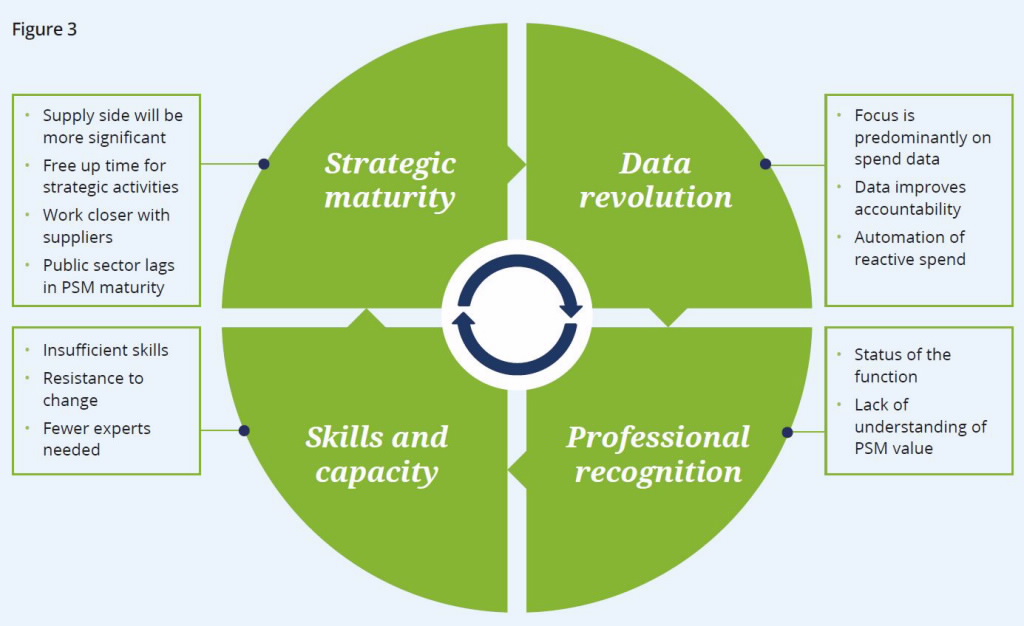
The persistence of these issues and a natural leaning towards incremental change create strategic blindspots. As an example, discussion in this study of new data and systems tended to centre on the ability to conduct current tasks more efficiently and effectively, rather than the potential game-changing, exponential gains and risks of transformative data and systems. Improved systems capability would facilitate management of more complicated supply systems and decisions, but were not necessarily seen as providing solutions for more complex issues such as network collaboration, or sourcing from highly dynamic markets.
Today’s best-in-class supply management functions are able to stimulate, facilitate and conduct cross-business discussion, decision-making and action on supply-side issues as part of the company’s overall strategy formulation and execution. Even here though, some reframing of supply-side priorities would be needed. In TITANS, a key challenge for PSM in the majority of organisations would be dealing with market concentration. In NETWORKED, a key challenge would be ensuring sufficient market dynamism. So, whilst TITANS and NETWORKED are mutually exclusive scenarios, it is notable that both would require greater attention to the long term development and shaping of markets.
The extent of change identified in the two scenarios raises questions about whether the essential foundations of PSM – sourcing, contracts, and market development activities – would be fit-for-purpose in these new environments. Consider, for example: what would be needed to enable real ‘agile sourcing’? How would organisations better balance private vs collective interests, and long-term vs short-term outcomes? Contracts and regulatory frameworks may not provide sufficient protection or incentive to handle asset-less business models, future data ownership, or collaborative networks. The ability to shape and steer markets requires influence, accountability and enabling predictive technologies. Preparation for PSM futures is critical as the commercial, environmental and social impacts of collective failure to manage supply-side issues could be extreme. But even our mode of response to change requires a wider arc of consideration.
The persistence of perennial issues and the difficulties in visioning potential futures suggest different approaches – such as scenario development and planning – are needed to stimulate rich debate on the future of PSM. In developing the two scenarios presented here, four lessons became apparent. The table right outlines the challenges and suggestions for tackling them.
Contracts and regulatory frameworks may not provide sufficient protection or incentive to handle asset-less business models, future data ownership, or collaborative networks.
Figure 4
| TITANS | THE CHALLENGE | TACTIC |
|---|---|---|
| Adopt an outside-in perspective | Avoiding incremental thinking about supply management |
|
| Generalise | Stretching thinking beyond current business arrangements and organisations. The basis for imagining the future is uncertain - ‘if we won’t be using the same technologies to produce the same products or services for the same customer bases, how can we predict our needs and how we will source them?’ |
|
| Be future-focused | Imagining a longer-term future. |
|
| Check for diversity | Focusing only on technological developments, or those considered more tangible |
|
The PSM community needs to initiate debate, challenge current practices and build capabilities and the capacity to develop new, appropriate supply management options, rather than sleepwalking into undesirable futures.
The combined influence of organisations’ procurement practices and decisions affects far more than their individual commercial performance. It generates market structures and dynamism. Issues of power and lack of corporate diversity have cumulative impacts on people, organisations, markets, the natural world, and society.
Both scenarios suggest that leaders need to identify, evaluate and challenge the assumptions and norms that frame typical efforts to plan for the strategic development of PSM. Strategic blindspots limit critical reflection. PSM professionals may find their field moving into a future that does not deliver what is needed by their organisations, that they don’t want, and for which they are not prepared.
The future of PSM is however not the exclusive concern of PSM leaders. It invites serious consideration from a range of stakeholders, including organisational leaders. Market concentration and dynamism in B2B markets are of interest to them and to external parties such as regulators. Discussion and debate needs to grow in scope from how to increase the strategic influence of PSM professionals within organisations, to include the wider impact of supply-side management choices, individually and collectively.
The scenarios represent two plausible futures. They are not predictions. Other futures are equally plausible. A crucial point apparent within these two scenarios is that supply managers are not passive actors within them. Supply-side management choices will shape the emerging landscape. Futures are organic, malleable and adaptive. The PSM community needs to initiate debate, challenge current practices and build capabilities and the capacity to develop new, appropriate supply management options, rather than sleepwalking into undesirable futures.
An extended version of this report is available on the CIPS website within the Knowledge area. The extended version describes the research process and provides links to further reading, resources and techniques for supply management experts interested in the future of PSM.
About CIPS, the Chartered Institute of Procurement & Supply
The professional body
CIPS, a not-for-profit organisation that exists for the public good, is the voice of the profession, promoting and developing high standards of skill, ability and integrity among procurement and supply chain professionals.
Quality guaranteed
Our qualifications are recognised by OFQUAL in England and regulators in various countries, demonstrating that they meet specific quality standards.
The Global Standard
CIPS Global Standard in Procurement and Supply, which is freely available, sets the benchmark for what good looks like in the profession.
A commercial organisation
CIPS helps governments, development agencies, and businesses around the world to excel in procurement and supply, supporting them to improve and deliver results and raise standards.
A global community
We are the world’s largest professional body dedicated to procurement and supply with a global community of over 200,000 professionals in over 150 countries, and offices in Africa, Asia, Australia, the Middle East, Europe and the USA.
Related pages
Content related to: The future of procurement and supply
On this page